
Three Changes Long-Running Agents Will Bring
The way companies use generative AI is changing.
Until recently, most people used AI to answer questions, summarize documents, or draft emails. A user entered a request, and the AI produced a single response.
AI agents are now moving beyond one-off outputs. They can search for information, analyze files, use external tools, review intermediate results, and continue working until they produce a final deliverable.
These systems are often called Long-Running Agents: AI agents designed to perform tasks over tens of minutes, several hours, or even longer.
Their significance goes beyond extended execution time. Long-Running Agents are changing how AI performance is evaluated, how enterprise AI systems are designed, and how work is divided between people and AI.
① The Focus Is Shifting from Good Answers to Completed Work
Early competition in generative AI centered on response quality. The key questions were whether a model could understand a request, provide accurate information, and generate natural-sounding text.
For Long-Running Agents, a good response is no longer enough.
An agent must break a goal into smaller tasks, use the necessary data and tools, and continue working until it produces the required result.
Consider a request such as:
Analyze last quarter’s sales performance and prepare a management report.
A conventional chatbot might summarize data supplied by the user or draft a report based on a spreadsheet. A Long-Running Agent could handle a broader workflow:
- Locate the relevant files in an internal repository.
- Identify missing or incorrect data.
- Clean and organize the dataset.
- Analyze major metrics and trends.
- Create charts and tables.
- Draft the report and review incomplete sections.
- Produce the final document in the required format.
This process may involve file retrieval, data analysis, code execution, and multiple API calls. If the output fails to meet a predefined standard, the agent may return to an earlier step and revise its work.
As a result, AI performance also needs to be measured differently. Organizations must look beyond whether the final answer sounds convincing. They also need to determine whether the agent completed the task, avoided unnecessary steps, and delivered the result within acceptable time and cost limits.
The first major change is therefore clear: the focus of generative AI is shifting from what it can say to what it can finish.
② Enterprise AI Competition Is Expanding from Models to Execution Environments
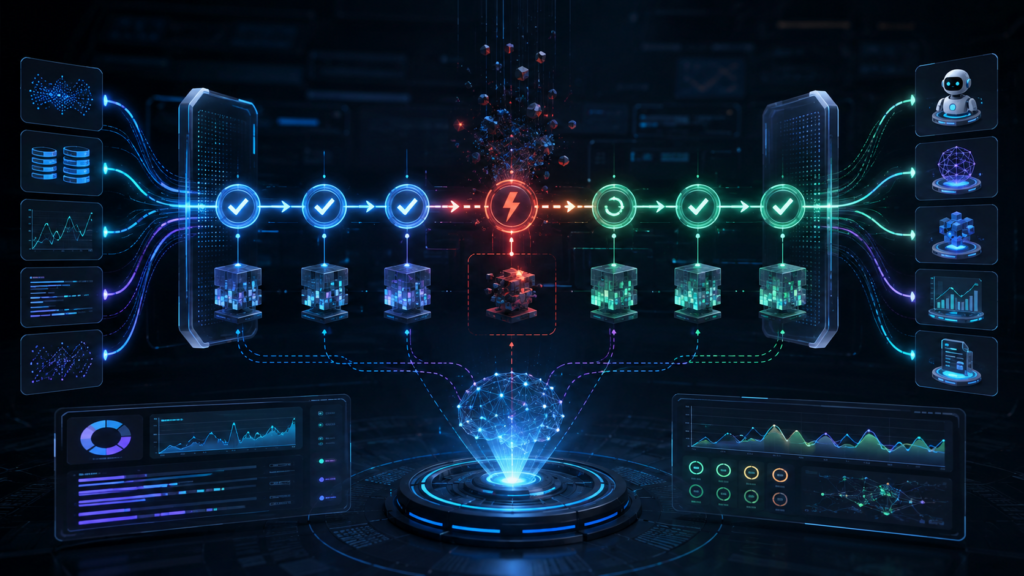
A capable AI model alone cannot reliably support work that continues for several hours.
During a long-running task, a network connection may fail, an external system may stop responding, or the agent may encounter an unexpected file format. It may also need to pause while waiting for human approval.
If every interruption forces the agent to start again from the beginning, it becomes difficult to use in real business operations. Previous results may be lost, and repeated execution increases both time and cost.
Long-Running Agents therefore require an execution environment that supports:
- State management for work in progress and intermediate outputs
- Checkpoints that save progress at defined stages
- Execution logs that show where and why an error occurred
- Automatic retries for temporary failures
- Resumption from the point where execution stopped
- Memory and context management for extended tasks
Checkpointing is particularly important. By saving the agent’s progress during execution, a system can restart from the latest checkpoint instead of repeating the entire workflow.
Context management presents another challenge. If every document, conversation, and tool result remains in the active context, the amount of information can become excessive. The agent may lose track of important decisions or repeat work that has already been completed.
A practical system must preserve essential information and current progress while summarizing or storing less important records externally.
This means enterprise AI performance will increasingly depend on more than model quality. Even when companies use the same underlying model, their results may differ significantly depending on how well they maintain task state, recover from failures, and trace each execution step.
The choice of model will remain important, but the agent runtime and operating environment around that model will become an equally significant source of competitive advantage.
③ Controllable Autonomy Will Matter More Than Full Automation
The ability to perform multi-step work does not mean that an AI agent should operate without human oversight.
Searching for information or preparing a document draft is relatively low risk. Sending a message to a customer, processing a payment, changing a contract, or deleting data can have direct financial, legal, and security consequences.
Organizations therefore need to define not only what should be automated, but also where human review is required.
An AI agent might classify customer inquiries and prepare response drafts, while a support representative approves each message before it is sent. Similarly, an agent could analyze data and write a report, while a human reviewer validates the final figures and conclusions.
This approach is commonly referred to as Human-in-the-Loop.
Before deploying Long-Running Agents, companies should establish clear rules for:
- Tasks the agent may perform independently
- Stages that require human review or approval
- Data and business systems the agent may access
- Separate permissions for viewing, creating, modifying, and deleting
- Usage and cost limits for each workflow
- Escalation and recovery procedures when errors occur
- Logging and audit requirements for the full execution process
Permissions should be limited to what the agent actually needs. An agent responsible for retrieving information does not necessarily require permission to delete records. An agent that drafts customer messages should not automatically be allowed to send them.
Cost also needs to be controlled. A Long-Running Agent may call models and tools repeatedly during a single workflow. Failed attempts and retries can increase expenditure quickly.
Companies should therefore examine not only token usage, but also the number of model calls, tool executions, and retries required to complete one business task. Lightweight models may be sufficient for classification and simple summaries, while more capable models can be reserved for complex reasoning and final validation.
The goal is not automation that removes people from every stage. It is controllable autonomy: allowing AI to operate independently within defined boundaries while ensuring that people can intervene at important moments and review the entire process.
Which Tasks Will Long-Running Agents Change First?
Long-Running Agents are not necessary for every type of work.
A conventional chatbot is often sufficient for answering a short question, summarizing a document, or drafting a single email. Applying a complex agent architecture to a simple task may only increase development and operational overhead.
Tasks that are better suited to Long-Running Agents tend to share several characteristics:
- They consist of multiple stages.
- They require access to several documents, systems, or tools.
- The next step depends on an intermediate result.
- Errors require revision or re-execution.
- Completion can be evaluated against reasonably clear criteria.
Likely use cases include extended research and report writing, market and competitor monitoring, data analysis, code modification and testing, and investigation of operational issues.
For example, a market-monitoring agent could regularly review multiple sources and compare new findings with previous results. Rather than simply listing search results, it could identify meaningful changes such as product launches, price updates, or new regulatory announcements.
A development agent could analyze a codebase, modify relevant files, run tests, and investigate any errors. It could continue revising the code until the results meet defined requirements.
By contrast, organizations should be cautious about assigning agents tasks with vague objectives, subjective completion criteria, or significant human accountability.
The Next Competitive Advantage Is the Ability to Finish the Job
Long-Running Agents show how AI is evolving from a conversational interface into a system that participates directly in business processes.
The standard for AI performance is expanding from producing good answers to completing real work. Model quality remains important, but so do state management, failure recovery, and execution traceability.
As agents become more autonomous, organizations must also define approval points, permissions, cost controls, and accountability more precisely.
Ultimately, the value of a Long-Running Agent does not come from operating continuously for several hours. It comes from its ability to carry complex work forward, recover when something goes wrong, involve people when necessary, and complete the task reliably.