
AI Agent Kill Switch: Why Stopping the Model Isn’t Enough
An AI agent starts behaving strangely. It accesses a file it normally never touches, calls an unexpected tool, or begins taking actions outside the workflow it was given.
Someone hits the kill switch.
Problem solved?
Not necessarily.
An AI agent kill switch should do more than stop the model or terminate a process. In a production environment, an agent may still have valid access tokens, queued jobs, active sessions, delegated tasks, or permissions across external systems. If those remain active, the reasoning process may have stopped while the authority behind it is still alive.
That distinction matters as AI agents move beyond answering questions and begin interacting with email, source code, enterprise applications, databases, cloud infrastructure, and APIs.
The real purpose of an AI agent kill switch is therefore not simply to stop computation.
It is to stop the agent from causing another effect.
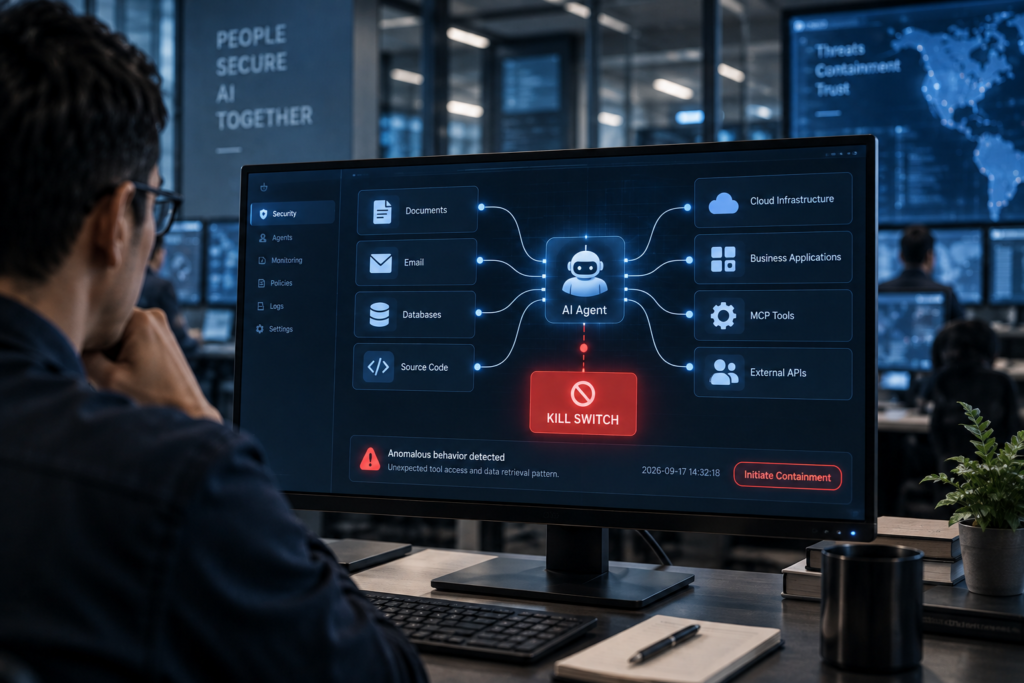
ai-agent-kill-switch?
An AI agent kill switch is a control that rapidly prevents an agent from taking further actions when its behavior becomes unsafe, unauthorized, or unpredictable.
At the simplest level, it can pause or terminate the agent process. A stronger implementation can also block new tool calls, invalidate credentials, revoke authorization, cancel queued work, stop delegated agents, and isolate the agent from external systems.
That difference is important because an enterprise agent is rarely a single process running in isolation.
An agent might reason in one environment, authenticate through an identity provider, access documents through another service, use an MCP server to invoke tools, trigger a cloud workflow, and delegate part of the job to another agent.
Each layer can have its own execution and authorization state.
Stopping one of them does not automatically stop the others.
This is closely related to the access-control problem behind MCP. As discussed in The Real Security Problem With MCP Isn’t the Protocol — It’s What Agents Can Access, a secure connection does not guarantee that the agent behind it has appropriate authority. A kill switch has to address that authority, not just the connection.
Why Are Kill Switches Becoming More Important for AI Agents?
Traditional applications generally execute logic that developers explicitly programmed. AI agents can select tools and intermediate actions dynamically based on a goal, context, retrieved information, model output, and the results of previous actions.
That flexibility is what makes agents useful. It also makes containment harder.
In February 2026, NIST published its Software and AI Agent Identity and Authorization concept paper, focusing on identification, authorization, auditing, delegation, prompt injection, and access to external tools in agentic systems.
NIST expanded on that issue in August 2026, arguing that agentic systems need stronger identity foundations, including tightly scoped and short-lived credentials rather than broadly shared or persistent access. The full discussion appears in Why Agentic AI Needs a Strong Identity Foundation.
The common thread is simple: as agents receive more authority, enterprises need a reliable way to take that authority back.
That changes what an emergency stop mechanism needs to accomplish.

The Red Button Is the Easy Part
The visual metaphor for a kill switch is simple: a large red button marked STOP.
The architecture behind it is not.
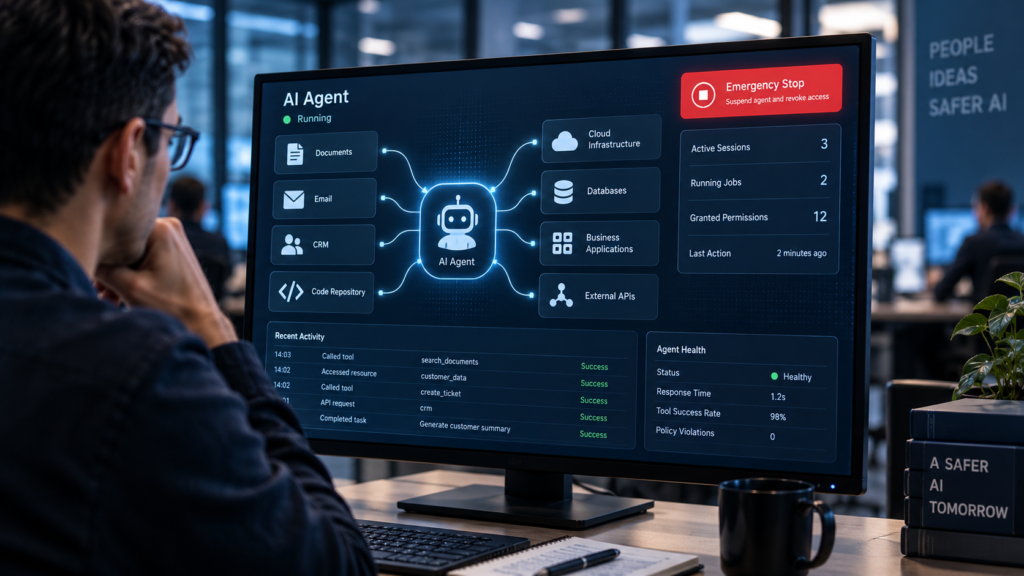
Imagine an enterprise AI agent that can search internal documents, read email, create support tickets, update CRM records, query financial information, and launch a cloud automation workflow.
During a task, monitoring detects unusual behavior and the organization immediately shuts down the agent runtime.
The model stops generating new decisions.
But an access token issued ten minutes earlier may still be valid.
A cloud workflow may already be executing.
A ticket-processing job may still be waiting in a queue.
A SaaS application may still consider the agent authenticated.
A sub-agent may already be handling the next part of the workflow.
This leads to one of the most important distinctions in agent security:
Process termination stops computation. Authority revocation stops capability.
A serious kill-switch architecture needs to address both.
What Should an AI Agent Kill Switch Actually Stop?
There is no single universal design because agent architectures vary widely. But a production kill switch should usually consider at least five layers.
1. Stop New Agent Execution
The first layer is the obvious one.
Prevent the agent from starting new reasoning cycles, accepting new tasks, generating additional plans, or spawning new instances.
Schedulers and orchestration platforms should stop assigning new work to that agent.
This shuts down the decision engine.
But it should be treated as the beginning of containment, not the end.
2. Block New Tool Calls
An agent should not be able to keep calling APIs, MCP tools, plugins, connectors, or internal automation just because those systems remain reachable.
The execution platform needs an independent policy enforcement point capable of denying new calls.
That separation matters.
Telling a model, “Do not use any more tools,” is not equivalent to technically removing its ability to use them.
A prompt is an instruction interpreted by a probabilistic system. An authorization layer is an enforcement mechanism.
Microsoft’s guidance on least privilege for AI agents follows the same principle. It recommends assigning agents unique identities, restricting them to explicit tools and data scopes, and testing revocation paths rather than relying only on model behavior.
For production systems, the safest design is one in which the agent cannot override the control that stops it.
3. Revoke Credentials and Tokens
This is where a simple shutdown model often fails.
Stopping an agent process does not automatically invalidate credentials that have already been issued.
An agent may possess OAuth access tokens, API keys, cloud credentials, database sessions, service-account credentials, certificates, or delegated user tokens.
Those credentials may remain usable until they expire or are explicitly revoked.
Okta provides a useful real-world example in its documentation for an AI agent kill switch. Disabling an agent can prevent it from obtaining new tokens, but existing tokens may still remain valid until they expire unless they are separately revoked.
That detail captures the problem better than the red-button metaphor.
A system can appear “disabled” while part of its authority remains active.
This is one reason short-lived credentials matter so much for AI agents. The shorter and more narrowly scoped the credential, the smaller the window between detection and effective containment.
4. Stop Queued and Delegated Work
Agentic systems are increasingly asynchronous.
An agent can make several decisions in rapid succession, submit jobs to external systems, and continue working while those jobs execute independently.
It can also delegate subtasks to other agents.
Suppose Agent A delegates research to Agent B and infrastructure changes to Agent C. Agent C then invokes a cloud automation workflow.
If security operators stop Agent A, what happens to B?
What happens to C?
What happens to the cloud workflow that C already launched?
The answer depends entirely on the architecture.
This creates a problem traditional process-level kill switches were not designed to solve.
Agent containment may need to follow the delegation chain.
Organizations therefore need enough identity and execution context to determine which agent initiated a task, which authority was delegated, which child processes were created, and which downstream actions are still running.
Without that lineage, the incident response team may know which agent misbehaved but still not know how far its actions traveled.
5. Preserve the Evidence
There is one thing the kill switch should not destroy: the audit trail.
Once an agent is stopped, investigators still need to know who initiated the task, which identity the agent used, what permissions were active, what data it accessed, which tools it called, and which actions succeeded.
They also need to know whether the agent delegated work and what remained active when containment began.
This is where AI agent observability starts to overlap with security.
The critical record is no longer just a model transcript.
Security teams need to reconstruct the execution path:
user → agent → identity → tool → resource → action
NIST’s ongoing Software and AI Agent Identity and Authorization project includes auditing and non-repudiation alongside identity and authorization, reflecting the fact that organizations need to understand not only what an agent was allowed to do, but also what it actually did.
Kill Switch, Guardrails, and Human Approval Are Different Controls
These concepts are often grouped together, but they solve different problems.
Guardrails try to prevent unsafe or disallowed behavior before an action proceeds.
Human approval inserts a person before selected high-impact actions.
A kill switch is a containment mechanism. It assumes something has already gone wrong, may be going wrong, or is risky enough that execution should stop immediately.
None replaces the others.
A practical control stack might look like this:
least privilege → policy enforcement → selective approval → continuous monitoring → emergency revocation
The kill switch sits near the end of that chain.
It is the control that matters when preventive mechanisms have not provided enough confidence.
There is also a reason not to rely excessively on human approval. NIST has warned that repeated approval requests can create the same kind of fatigue seen with frequent MFA prompts. If users are asked to approve too many actions, they may eventually approve them without meaningful review.
Human oversight matters, but “ask a human every time” is not a complete security architecture.
Should an AI Agent Kill Switch Be Automatic?
Not necessarily.
There are two useful models.
A manual kill switch allows an administrator or security operator to suspend an agent after reviewing suspicious behavior.
An automated circuit breaker can temporarily restrict an agent when predefined conditions are detected.
Possible triggers might include access to a prohibited resource, repeated authorization failures, an unusual tool sequence, abnormal transaction volume, unexpected data movement, or an attempted privilege escalation.
The two approaches can work together.
An automated policy could immediately pause high-risk actions while a human decides whether the agent’s identity and credentials should be fully revoked.
That avoids two extremes: allowing a potentially unsafe agent to continue indefinitely while waiting for a person, or letting an imperfect anomaly detector permanently shut down a critical workflow.
The enforcement mechanism should also remain outside the agent itself.
An agent should not be the final authority on whether its own kill switch applies.
A Better Model: Pause, Revoke, Isolate
Instead of imagining one giant red button, enterprise teams may find it more useful to think in terms of three separate containment states.
Pause
Stop new reasoning, jobs, and tool execution while preserving the current state.
This is useful when behavior looks suspicious but investigators still need context.
Revoke
Remove the agent’s ability to authenticate or authorize actions.
That can include invalidating tokens, rotating credentials, removing temporary roles, and canceling delegated authority.
Isolate
Disconnect the agent from selected external systems while keeping the runtime available for investigation.
For example, an organization might block external communication and production infrastructure access while still allowing security teams to inspect logs and execution state.
These controls can be used independently or together.
That is a more realistic model than treating agent security as simply ON or OFF.
How Should Companies Test an AI Agent Kill Switch?
The first step is not building the button.
It is mapping the authority behind the agent.
Organizations need an inventory of agent identities, tools, credentials, MCP servers, APIs, downstream systems, queues, workflows, and delegated agents.
Microsoft’s least-privilege guidance for AI agents recommends this type of end-to-end review, including dedicated identities, explicit scopes, revocation testing, and downstream enforcement.
A practical kill-switch test should answer questions such as:
- If we disable the agent now, can an existing token still be used?
- Can a queued job continue to execute?
- Can a delegated agent keep working?
- Can the agent reconnect automatically under a new session?
- Can an MCP server still accept previously issued credentials?
- Can a cloud workflow already launched by the agent continue changing infrastructure?
- Can the security team reconstruct everything that happened before shutdown?
If those answers are unknown, the kill switch has not really been tested.
An emergency control first evaluated during an emergency is not much of a control.
Why Revocation May Become a Core AI Agent Platform Feature
Most of the AI industry’s attention has focused on expanding what agents can do.
They can use more tools, operate across more systems, plan longer workflows, and work with less direct supervision.
The opposite capability is becoming just as important:
How quickly can all of that authority be taken away?
NIST’s current work on agent identity reflects this transition. The issue is no longer simply identifying an AI application. Enterprises increasingly need to understand what authority an agent possesses, whose authority it is acting under, what it can delegate, and how those privileges can be audited and revoked.
That suggests kill-switch functionality may eventually become less of a standalone feature and more of a standard property of enterprise agent platforms.
A mature platform may need native support for rapid token invalidation, session termination, task cancellation, delegation revocation, tool-level blocking, temporary isolation, and end-to-end execution tracing.
In that architecture, the visible button is almost the least interesting part.
The real kill switch is the revocation infrastructure behind it.
FAQ
What is an AI agent kill switch?
An AI agent kill switch is a containment mechanism that prevents an agent from taking further actions. A complete implementation can stop execution, block tools, revoke credentials, cancel pending work, terminate delegated authority, and isolate the agent from external systems.
Is stopping the AI model enough?
Usually not. Stopping the model ends new inference, but valid access tokens, active sessions, queued jobs, delegated agents, and already triggered external workflows may remain active.
What is the difference between an AI kill switch and AI guardrails?
Guardrails are primarily preventive. They try to keep an agent within predefined behavioral or policy boundaries. A kill switch is a response and containment mechanism used when execution must be interrupted or authority revoked.
Should every AI agent have a kill switch?
The required containment mechanism should reflect the agent’s potential impact. A read-only research assistant presents a different risk from an agent that can modify production infrastructure, transfer data, send external communications, or execute financial transactions.
Where should the kill switch be enforced?
Critical enforcement should sit outside the model’s own reasoning process. Identity providers, API gateways, policy engines, orchestration platforms, MCP hosts, and downstream applications can all participate in containment.
Can a disabled AI agent still have valid access?
Yes. Depending on the system, existing tokens or sessions may remain valid after the agent itself is disabled. That is why explicit token revocation and short-lived credentials are important parts of agent containment.