South Korea AI-RAN Market 2026: Why Telecom Networks Are Becoming AI Infrastructure
South Korea is emerging as one of the most active testing grounds for AI-RAN in 2026.
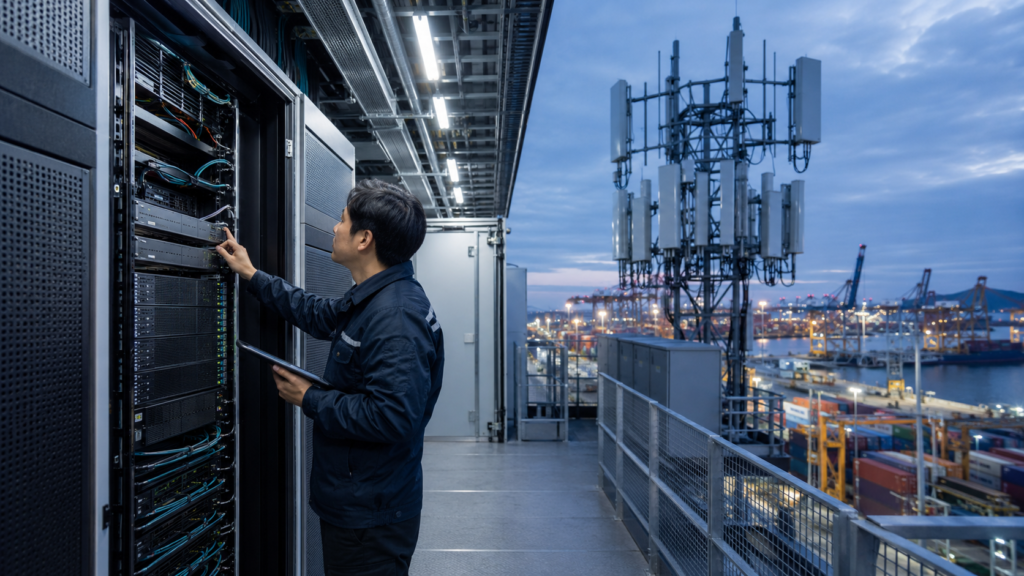
The country is not yet a mature commercial AI-RAN market. Most deployments are still pilots, testbeds or government-backed demonstrations. But the direction is becoming clear: South Korean telecom operators are beginning to combine 5G Standalone, AI-driven network automation, edge computing and physical AI within the same infrastructure.
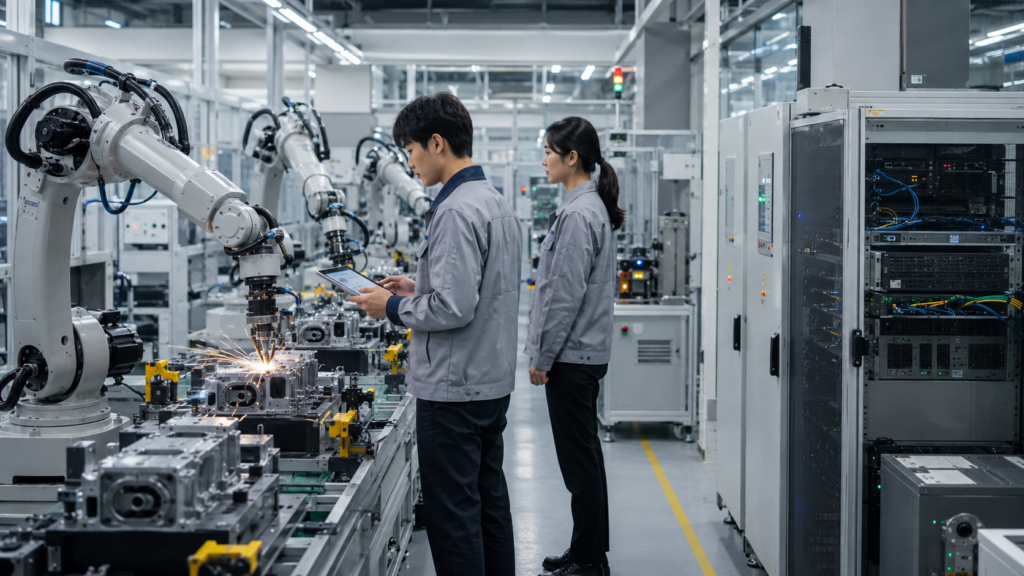
In July 2026, South Korea’s Ministry of Science and ICT and the National Information Society Agency launched a KRW 17.206 billion Hyper-AI Network project. SK Telecom and KT are leading two consortia that will deploy AI-RAN-enabled 5G-SA networks in manufacturing plants and shipyards and test them with physical AI applications such as welding, painting and inspection robots. (nia.or.kr)
That makes the South Korea AI-RAN market worth watching for a simple reason: AI-RAN is beginning to move from telecom laboratories into real industrial environments.
What Is AI-RAN?
AI-RAN, or Artificial Intelligence Radio Access Network, refers to the integration of AI technologies and computing resources into radio access network infrastructure.
It generally covers three related areas:
- AI for RAN: using AI to improve network performance, energy efficiency and radio resource management.
- AI and RAN: allowing AI and telecom workloads to share computing infrastructure.
- AI on RAN: using network infrastructure to support AI applications closer to users, devices and machines.
The AI-RAN Alliance increasingly emphasizes all three. At MWC 2026, the organization said it had grown to 132 members and was developing reference architectures, workload orchestration frameworks and edge AI use cases for AI-native networks. (ai-ran.org)
This broader definition is important because AI-RAN is not simply about making mobile networks more intelligent. It could also change where AI computing happens.
Why Is South Korea Investing in AI-RAN?
South Korea has several conditions that make AI-RAN particularly relevant. The country already has advanced mobile infrastructure, major telecom operators, strong semiconductor and manufacturing industries and growing investment in robotics and physical AI.
But the most important factor is that Korea is now testing AI-RAN in places where network performance directly affects machines.
The government-backed Hyper-AI Network project will deploy AI-RAN-enabled 5G-SA networks in shipyards and manufacturing facilities. The networks will be compared with existing infrastructure on metrics including upload performance, latency, latency variation and autonomous operation. (nia.or.kr)
NIA also launched a separate field demonstration in July combining private 5G AI-RAN infrastructure with physical AI services using domestic technologies across the network and robotics stack. NIA described it as Korea’s first on-site demonstration integrating private 5G AI-RAN with physical AI. (nia.or.kr)
These projects give Korea’s AI-RAN development a clear industrial focus. The question is not merely whether AI can improve a mobile network. It is whether the network can support robots and AI systems that need low latency, high reliability and continuous connectivity in the physical world.
How Is SK Telecom Approaching AI-RAN?
SK Telecom is currently one of the most visible Korean operators in AI-RAN.
In July 2026, the company was selected as a lead organization for the Hyper-AI Network project. Its consortium plans to build AI-RAN pilot infrastructure using equipment from multiple vendors and test three physical AI services in industrial environments. (news.sktelecom.com)
SK Telecom is also the only Korean telecom operator currently serving on the board of the AI-RAN Alliance, which gives it direct exposure to global work on AI-native RAN architectures and commercialization models. (ai-ran.org)
The company’s strategy also extends beyond the radio network.
SK Telecom is simultaneously expanding AI data center infrastructure. In July, it announced plans for up to 15 GW of AI data center capacity and created a dedicated subsidiary, SK Hyper, to pursue large-scale AI infrastructure projects. (news.sktelecom.com)
These investments point to a broader strategy in which telecom networks, AI data centers and edge computing become increasingly connected. That is one reason AI-RAN should not be viewed only as a telecom equipment category.
What Is LG Uplus Doing With AI-RAN?
LG Uplus is approaching AI-RAN from a slightly different angle.
In August 2026, the company and Yonsei University tested seamless network switching between LG Uplus’s commercial 5G network and an AI-RAN test network. The goal was to maintain service continuity even when a device moved between different network environments. (news.lguplus.com)
That may sound like a narrow technical experiment, but it addresses an important requirement for physical AI.
A robot, drone or autonomous machine cannot simply stop operating because it moves out of one test network and into another.
For AI-RAN to become useful outside controlled environments, devices need to remain connected across commercial networks, private networks and edge infrastructure. The LG Uplus–Yonsei test therefore highlights one of the practical issues the market will need to solve before large-scale adoption.
Why Does AI-RAN Matter for Physical AI?
Physical AI is one of the strongest potential demand drivers for AI-RAN.
Traditional cloud AI often follows a simple pattern:
Device → Network → Data Center → AI Model → Response
That works well when a few hundred milliseconds do not matter.
But industrial robots, autonomous vehicles and real-time machine control may need much faster responses.
AI-RAN creates another possibility:
Device → Nearby Network Compute → AI Inference → Immediate Action
Not every AI workload will move to the network edge. Large models and computationally intensive training will still depend heavily on centralized AI data centers.
But some inference tasks can benefit from being processed closer to the machine. That is why AI-RAN, edge AI and physical AI are increasingly discussed together.
The network becomes more than connectivity infrastructure. It becomes part of the distributed AI computing architecture.
How Does AI-RAN Change Network Automation?
AI-RAN also expands the meaning of network automation.
Traditional automation generally follows predefined rules:
Detect a condition → Execute a programmed response
AI-native networks aim for something more adaptive:
Observe → Predict → Decide → Act → Verify
That introduces capabilities such as predictive network optimization, automated resource allocation and eventually more autonomous network operations.
The AI-RAN Alliance now has a dedicated Agentic AI task group exploring the use of AI agents for autonomous network operations and management. (ai-ran.org)
This creates an important connection between two markets that are often discussed separately: network automation and AI-RAN.
Network automation reduces manual operations. AI-RAN could eventually allow the network to make more operational decisions based on current conditions rather than relying entirely on preconfigured rules.
That is also where the risks become more serious.
Telecom networks are critical infrastructure. An AI system that incorrectly changes radio resources or network policies can affect thousands or millions of users.
For that reason, AI-RAN adoption will depend not only on AI model quality but also on observability, policy controls, security, interoperability and human oversight.
Is South Korea Already a Commercial AI-RAN Market?
Not yet.
This distinction matters.
Most of South Korea’s notable AI-RAN activity in 2026 is still based on research, test networks and field demonstrations rather than nationwide commercial deployment.
The current market is better described as an early commercialization and validation stage.
However, several signals suggest that the market is moving beyond basic research:
- Government funding is supporting real industrial deployments.
- Telecom operators are testing AI-RAN outside laboratories.
- Physical AI applications are being included in network trials.
- Commercial 5G networks are being connected to AI-RAN test environments.
- Global AI-RAN standardization and commercialization efforts are accelerating.
Globally, the AI-RAN Alliance had already reached 132 members by February 2026, up from 75 members a year earlier. (ai-ran.org)
That does not guarantee rapid commercial adoption, but it does show that AI-RAN is developing into a broader telecom ecosystem rather than remaining a niche research concept.
What Will Drive the South Korea AI-RAN Market?
Several factors are likely to determine how quickly the market develops.
Physical AI adoption is probably the most important. If factories, shipyards, logistics centers and other industrial sites deploy more autonomous machines, demand for low-latency and reliable AI connectivity should increase.
5G-SA and private 5G deployment will also matter because many AI-RAN use cases depend on programmable, low-latency network infrastructure.
Edge computing capacity is another factor. AI-RAN becomes more valuable when telecom infrastructure can provide useful computing resources close to users and machines.
Standards and interoperability may be equally important. AI-RAN has to work across equipment vendors, chips, cloud platforms and network operators if it is going to scale.
Finally, the transition toward 6G could accelerate adoption. South Korea is already participating in international standardization work related to AI and 6G security, reflecting the broader expectation that future mobile networks will become more AI-native. (msit.go.kr)

How Is AI-RAN Different From Traditional Network Automation?
The simplest distinction is this:
Network automation automates how networks are operated. AI-RAN changes both how networks operate and what the network infrastructure can do.
Traditional automation focuses mainly on tasks such as configuration, monitoring, provisioning and fault response.
AI-RAN adds another layer by combining AI-driven optimization with shared computing resources and edge AI services.
That is why the South Korea AI-RAN market overlaps with several adjacent markets:
- network automation
- software-defined networking
- edge AI
- private 5G
- autonomous networks
- AI infrastructure
- AI data centers
- physical AI
Over time, those categories may become increasingly difficult to separate.
What Is the Outlook for the South Korea AI-RAN Market?
The near-term outlook is likely to be driven more by industrial trials and infrastructure validation than mass commercial deployment.
Manufacturing sites, shipyards and private 5G environments are logical starting points because they offer controlled environments and clear performance requirements.
If those deployments demonstrate measurable benefits in latency, reliability, resource efficiency or operational automation, broader commercial adoption could follow.
The larger opportunity may come later.
As AI moves from cloud-based assistants into robots, machines and autonomous systems, telecom networks may need to provide not only connectivity but also computing, inference and automated resource management.
That would significantly expand the role of the network.
For decades, telecom infrastructure was built primarily to transport data.
AI-RAN points toward a different model:
a network that connects devices, allocates computing resources, optimizes itself and helps run AI applications at the same time.
South Korea is still at the beginning of that transition.
But in 2026, it is becoming one of the places where that idea is being tested in the real world.