Why the World Is Building a Common Language for AI Agents
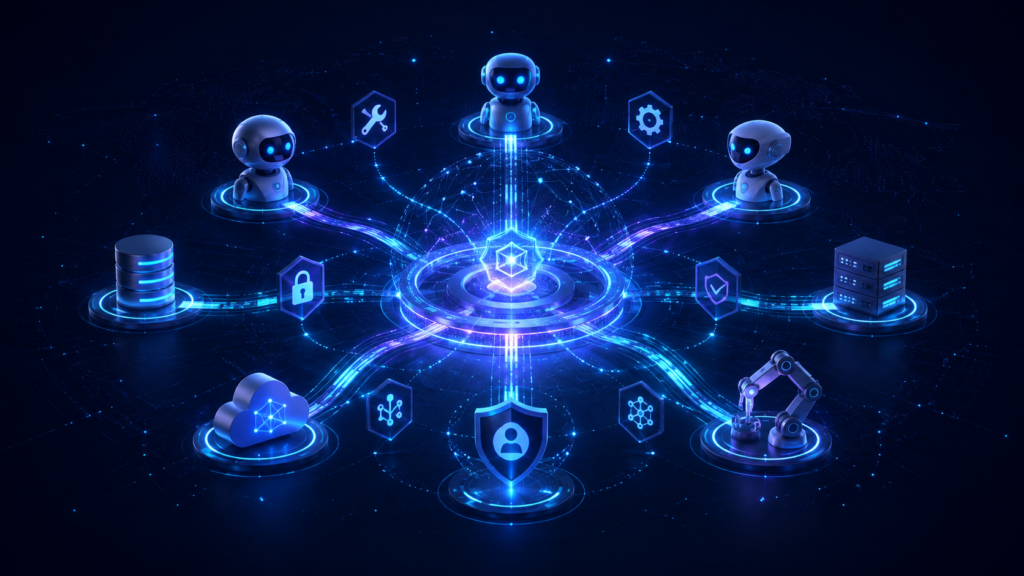
AI agents are becoming capable of doing more than answering questions. They can search company data, use software tools, coordinate tasks, and complete work across several systems.
But there is a basic problem.
An agent built by one company may not know how to work with an agent, tool, or service built by another.
Without shared protocols, every connection requires custom development. That makes agent systems expensive to build, difficult to maintain, and highly dependent on individual platforms.
This is why technology companies, open-source foundations, and standards bodies are now working on a common language for AI agents.
AI Agents Have an Integration Problem
Consider a corporate travel agent asked to arrange an overseas business trip.
It may need to access:
- an employee’s calendar,
- airline and hotel services,
- a corporate expense system,
- a payment tool,
- and an internal approval process.
If every service communicates differently, the agent needs a separate connector for each one. The problem becomes even more complicated when it must delegate part of the task to another agent built on a different platform.
Traditional software solved similar problems through shared standards such as HTTP, email protocols, and APIs. AI agents are now reaching the point where they need their own interoperability layer.
MCP and A2A Solve Different Problems
The emerging agent ecosystem is unlikely to rely on a single protocol. Different standards are being developed for different types of connections.
MCP Connects Agents to Tools and Data
The Model Context Protocol, or MCP, is an open standard for connecting AI applications to external data, tools, and workflows. It gives agents a consistent way to access systems such as databases, local files, search engines, and business applications. (Model Context Protocol)
MCP is often compared to USB-C. It does not determine what a connected tool does. It provides a standard way for different systems to connect.
In simple terms:
MCP helps an agent use tools and information.
A2A Connects Agents to Other Agents
The Agent2Agent protocol, known as A2A, focuses on communication between agents. It allows agents built with different frameworks to describe their capabilities, discover one another, exchange tasks, and coordinate work. (Linux Foundation)
The distinction is straightforward:
MCP connects agents to tools.
A2A connects agents to other agents.
A2A is now hosted by the Linux Foundation and, as of April 2026, had support from more than 150 organizations as well as integrations across major cloud platforms. (Linux Foundation)
Standards Are Also a Platform Battle
Shared protocols are not only a technical issue. They also influence market power.
The standard that becomes widely adopted can shape:
- how agents discover services,
- how tools describe their capabilities,
- which platforms are easiest to integrate,
- and how developers build agent-based products.
A closed protocol can strengthen one company’s ecosystem and make it harder for customers to move elsewhere. An open protocol can reduce that dependency by allowing agents and tools from different vendors to work together.
This is why neutral governance matters. Moving protocols such as A2A to the Linux Foundation can reduce the risk that a single vendor controls the rules of the broader ecosystem. (Linux Foundation)
The next AI platform battle may therefore be about more than which company has the strongest model.
It may also be about which standards everyone else decides to support.
Communication Does Not Automatically Create Trust
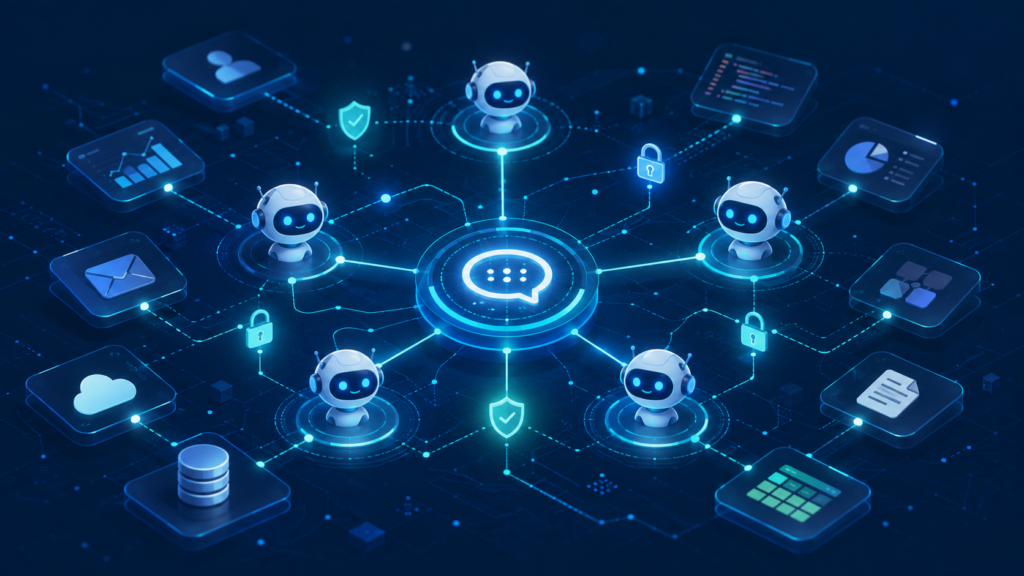
Interoperability makes agents more useful, but it can also make failures spread more easily.
If an agent can discover tools, communicate with other agents, and act across several systems, a compromised or poorly controlled agent may cause damage beyond its original environment.
A common protocol can standardize communication. It cannot prove that every participant should be trusted.
Before accepting a task from another agent, a system may still need to verify:
- who operates the agent,
- who it represents,
- what authority it has,
- how long that authority remains valid,
- and whether its actions can be traced.
This is why agent identity, authentication, authorization, and security are increasingly being discussed alongside interoperability.
In February 2026, NIST launched its AI Agent Standards Initiative, focusing on open protocols, interoperability, agent security, authentication, and identity infrastructure. (NIST)
The common language of agents will therefore need more than message formats.
It will also need rules for trust and accountability.
What Companies Should Watch
Companies do not need to choose one permanent standard yet. The ecosystem is still developing.
But they should already ask three questions.
Can the Agent Work Across Platforms?
A system that depends completely on one vendor’s tools, identity layer, and orchestration platform may become difficult to replace later.
Can Permissions and Actions Be Traced?
Organizations should be able to identify which agent requested an action, what authority it used, and what result followed.
Is Security Built Into the Protocol?
Authentication, authorization, permission limits, and revocation should not be treated as optional features added after deployment.
The Cha Signal View
The race to build a common language for AI agents is not simply about making integration easier.
It is about defining the basic rules of a new digital ecosystem.
Web standards allowed browsers and servers from different companies to communicate. Agent standards may eventually allow autonomous systems to find one another, use tools, exchange tasks, and act across organizational boundaries.
But the most useful standard will not be the one that allows the largest number of agents to communicate.
It will be the one that can answer four questions clearly:
Who is this agent?
Who does it represent?
What is it allowed to do?
Who is responsible for the result?
The next major AI platform may not be built around the smartest model.
It may be built around the language every other agent learns to speak.