South Korea AI Infrastructure Map: Key Companies Across the Value Chain
Recent attention has turned to Morgan Stanley’s AI infrastructure value-chain map. What made the map interesting was that it did not explain the AI industry solely through NVIDIA or GPUs. Instead, it presented the entire structure, from semiconductor design and manufacturing to memory, power, cooling, and data centers.
The map is also a reminder that AI infrastructure cannot be built with powerful chips alone.
Companies are needed to design and manufacture those chips. High-performance memory and advanced packaging must support them. Networks are required to connect thousands of servers, while electricity is needed to run them and cooling systems are essential to manage the heat they generate.
Data centers, cloud services, and AI development and operations platforms must then bring all these resources together before they can be turned into services that businesses and consumers can actually use.
So, what roles do South Korean companies play across this value chain?
I wanted to look beyond familiar names such as Samsung Electronics and SK hynix and understand the broader structure of the domestic AI industry. As part of that process, I created a map connecting major South Korean companies across the AI infrastructure value chain, from semiconductors to AI platforms.
How Is South Korea’s AI Infrastructure Map Organized?
Instead, it divides the AI infrastructure ecosystem into functional areas and places representative South Korean companies within each category.
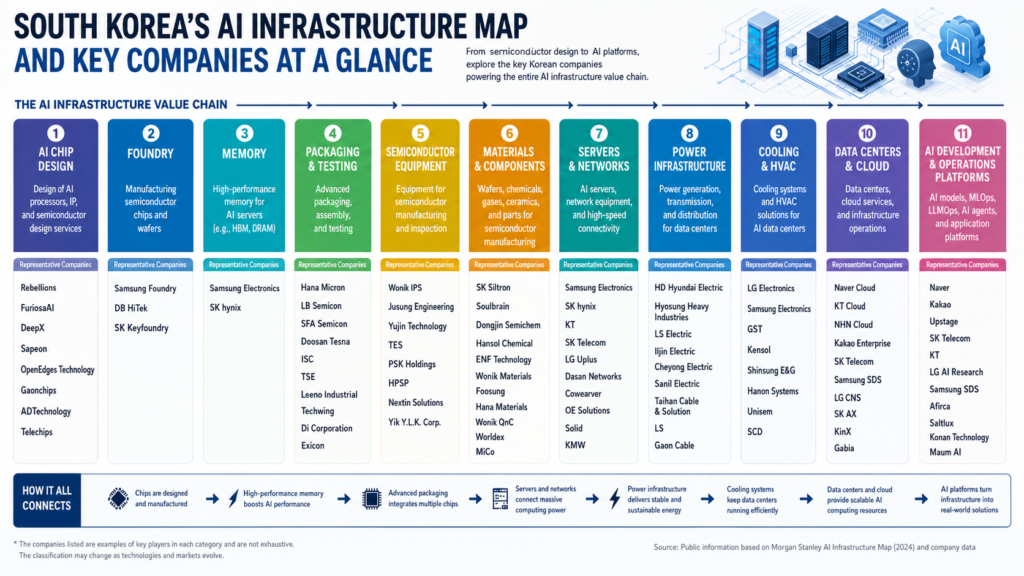
The overall value chain can be summarized as follows:
AI chip design → foundry → memory → packaging and testing → semiconductor equipment → materials and components → servers and networks → power infrastructure → cooling and HVAC → data centers and cloud → AI development and operations platforms
These stages do not operate independently.
As AI accelerators become more powerful, they require faster memory and more advanced packaging. As the number of servers increases, demand for networking and electricity also rises. Higher power consumption, in turn, makes cooling infrastructure more important.
The map is therefore more useful when viewed as a connected industrial structure rather than simply as a list of well-known companies.
① AI Chip Design
This area includes companies that design NPUs and other AI accelerators, as well as businesses providing semiconductor IP and chip design services.
Major companies: Rebellions, FuriosaAI, DEEPX, Sapeon, OpenEdges Technology, Gaonchips, ADTechnology, Telechips, and others
Rebellions, FuriosaAI, and DEEPX develop domestic AI processors for inference and edge computing environments.
OpenEdges Technology provides semiconductor IP, while Gaonchips and ADTechnology act as design houses that help translate chip designs into products that can be manufactured by foundries.
This is the starting point of South Korea’s AI semiconductor ecosystem. Many of its leading companies remain privately held, and much of the market is still in an expansion phase.
② Foundries
Foundries manufacture semiconductor designs on physical wafers.
Major companies: Samsung Electronics, DB HiTek, SK keyfoundry
Samsung Electronics is South Korea’s leading integrated semiconductor company, with both advanced foundry and memory capabilities.
DB HiTek and SK keyfoundry focus primarily on mature-node processes used for power management, analog, display driver, and other specialized chips.
Advanced process nodes receive the most attention in AI semiconductor discussions. However, data centers require more than AI accelerators. They also depend on power-management chips, controllers, and various supporting semiconductors, making mature-node foundries an important part of the ecosystem.
③ Memory
Memory enables AI servers to process large volumes of data at high speed.
Major companies: SK hynix, Samsung Electronics
High Bandwidth Memory, or HBM, has become one of the most important components in the AI semiconductor value chain. It is positioned close to GPUs and AI accelerators so that large amounts of data can be transferred rapidly.
This is one of the main reasons SK hynix and Samsung Electronics occupy such important positions in the global expansion of AI infrastructure.
Even the most powerful processor cannot operate efficiently if it does not receive data quickly enough. Memory is no longer simply a storage component. It has become a critical factor in overall AI system performance.
④ Packaging and Testing
This area connects multiple chips so they can operate as a single system and tests whether completed semiconductors function properly.
Major companies: Hanmi Semiconductor, Hana Micron, Nepes, LB Semicon, SFA Semicon, Doosan Tesna, ISC, TSE, LEENO Industrial, Techwing, DI Corporation, Exicon, and others
AI accelerators and HBM must be positioned close together to reduce data-transfer delays. This has increased the importance of advanced packaging technologies that can connect multiple chips with high precision.
Hanmi Semiconductor supplies equipment used in the HBM production process. Hana Micron, Nepes, and SFA Semicon operate in packaging and outsourced semiconductor assembly and testing.
Doosan Tesna, ISC, TSE, and LEENO Industrial are involved in semiconductor testing, test sockets, probe cards, and related components.
Backend processes once received less attention than wafer fabrication. As AI semiconductor architectures become more complex, however, packaging and testing are increasingly important in determining performance and production yield.
⑤ Semiconductor Equipment
This category covers equipment used to manufacture and inspect semiconductors.
Major companies: Wonik IPS, Jusung Engineering, Eugene Technology, TES, PSK, HPSP, NEXTIN, Koh Young Technology, INTEKPLUS, YIK Corporation, and others
Wonik IPS, Jusung Engineering, Eugene Technology, and TES supply equipment used in core manufacturing processes such as deposition and thermal treatment.
PSK and HPSP have strengths in specialized processes such as photoresist removal and high-pressure annealing. NEXTIN, INTEKPLUS, and Koh Young Technology provide inspection and metrology solutions.
Growing demand for AI semiconductors and HBM eventually leads to production-line expansion and process upgrades. This is why equipment suppliers can benefit even though they do not manufacture chips themselves.
⑥ Semiconductor Materials and Components
This area supplies wafers, specialty gases, chemicals, ceramics, quartz parts, and other materials required for semiconductor manufacturing.
Major companies: SK Siltron, Soulbrain, Dongjin Semichem, Hansol Chemical, ENF Technology, Wonik Materials, Foosung, Hana Materials, Wonik QnC, Worldex Industry & Trading, MiCo, and others
Semiconductors are produced through hundreds of manufacturing steps. The purity of process materials and the precision of equipment components can directly affect product quality and production yield.
As process nodes become smaller and chip structures become more complex, technical requirements for materials and components also increase.
Many companies in this category may be unfamiliar to general consumers, but they provide the foundation that keeps semiconductor production lines operating.
⑦ Servers and Networks
This area covers the servers that contain AI semiconductors and the networking infrastructure connecting servers and data centers.
Major companies: Samsung Electronics, SK hynix, KT, SK Telecom, LG Uplus, DASAN Networks, COWEAVER, OE Solutions, Solid, KMW, and others
AI data centers are not built around individual servers working independently. Large numbers of GPUs and servers must exchange data at extremely high speeds, making high-performance networking and optical communication infrastructure essential.
South Korean companies do not currently dominate the global AI server market. However, a number of domestic companies participate in telecommunications networks, optical transmission equipment, and network components.
As AI usage expands from large-scale model training to distributed inference services, low-latency connectivity between systems and data centers is likely to become even more important.
⑧ Power Infrastructure
Power infrastructure transmits electricity to data centers and distributes it reliably to servers and supporting facilities.
Major companies: HD Hyundai Electric, Hyosung Heavy Industries, LS ELECTRIC, Iljin Electric, Cheryong Electric, Sanil Electric, Taihan Cable & Solution, LS, Gaon Cable, and others
HD Hyundai Electric and Hyosung Heavy Industries manufacture transformers and other power equipment. LS ELECTRIC supplies power distribution and automation systems, while Taihan Cable & Solution and Gaon Cable provide cables used in power-grid construction.
AI data centers consume enormous amounts of electricity continuously.
Even when GPUs and servers are available, delays in grid connections or power supply can prevent a data center from beginning operations on schedule.
Electricity should therefore be viewed not as a supporting element, but as one of the main factors determining how quickly AI infrastructure can be built.
⑨ Cooling and HVAC
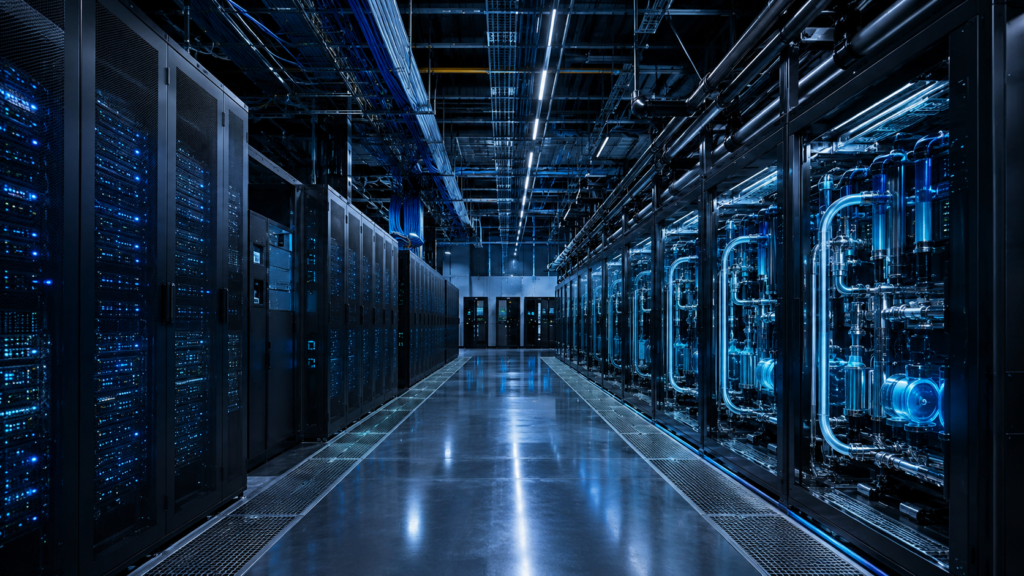
Cooling and HVAC systems manage the heat generated by high-performance AI servers.
Major companies: LG Electronics, Samsung Electronics, GST, K-Ensol, Shinsung E&G, Hanon Systems, Unisem, SCD, and others
AI servers consume more electricity than conventional servers and therefore produce significantly more heat.
Without sufficient cooling, server performance and equipment lifespan may decline, while overall data-center operating costs can rise.
Alongside conventional air cooling, direct liquid cooling and immersion cooling are receiving greater attention. These technologies bring coolant closer to computing equipment or immerse systems in specialized cooling fluids.
Cooling is no longer merely an auxiliary facility. It has become a core part of AI infrastructure that affects both computing performance and energy efficiency.
⑩ Data Centers and Cloud Services
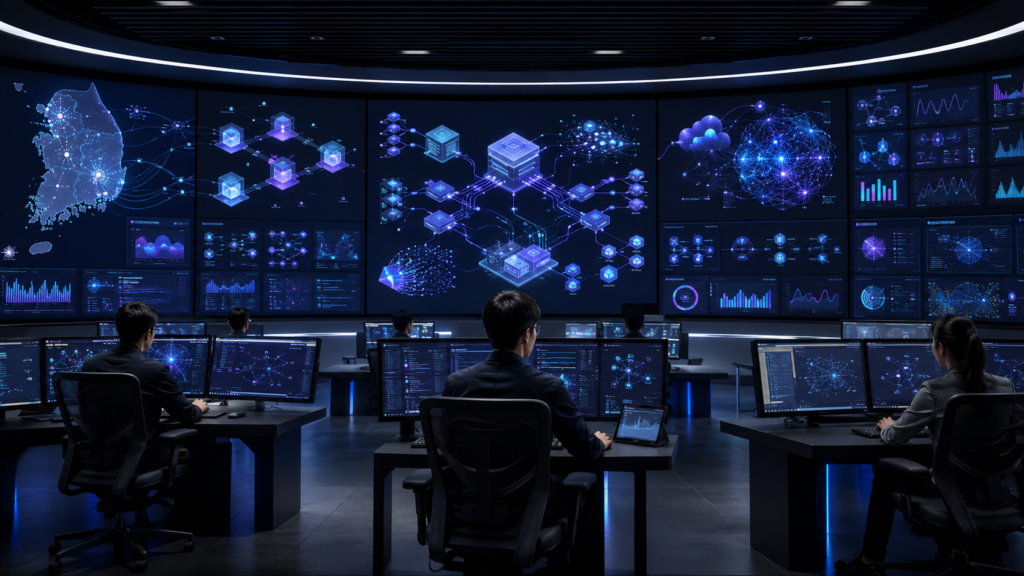
This category brings together servers, networks, power systems, and cooling facilities to operate AI infrastructure at scale.
Major companies: NAVER Cloud, KT Cloud, NHN Cloud, Kakao Enterprise, SK Telecom, Samsung SDS, LG CNS, SK AX, KINX, Gabia, and others
NAVER Cloud, KT Cloud, and NHN Cloud operate cloud and AI computing infrastructure.
Samsung SDS, LG CNS, and SK AX support enterprise and public-sector customers with data-center construction, cloud migration, system integration, and operations.
KINX provides internet data-center and network-connectivity services, while telecommunications companies are expanding their AI data-center and GPU-based service businesses.
Modern AI data centers are no longer simply buildings where servers are stored. They increasingly function as integrated industrial platforms combining electricity, networks, cooling, computing capacity, and cloud services.
⑪ AI Development and Operations Platforms
This category includes platforms used to develop, train, deploy, and operate AI models, large language models, and AI agents.
Major companies: NAVER, Kakao, Upstage, SK Telecom, KT, LG AI Research, Samsung SDS, Africa, Saltlux, Konan Technology, Maum AI, and others
The category includes not only companies developing proprietary AI models, but also businesses that provide MLOps, LLMOps, RAG, model deployment, and AI agent development platforms.
Africa provides Cheetah MLOps and LLMOps, along with Serengeti AI Agent Studio. Its solutions support a connected workflow from model development and LLM operations to AI agent creation, integration, and deployment.
Semiconductors and data centers provide the physical foundation on which AI runs. Development and operations platforms connect that infrastructure to actual business applications and services.
As investment in AI infrastructure grows, value will not remain concentrated entirely in hardware. Software that helps organizations use GPUs efficiently and operate models and AI agents reliably will also become increasingly important.
The Broader Structure Makes Individual Companies Easier to Understand
While organizing this map, I was reminded that the AI industry cannot be explained through only a few representative companies.
The ecosystem includes semiconductor designers and foundries, but it also depends on memory, packaging, equipment, materials, networks, electricity, cooling, data centers, cloud services, and software platforms.
This map does not include every company. Some businesses operate across several categories, and classifications may change as technologies and markets evolve.
Even so, looking at the overall structure makes it easier to understand what role each company plays and how the different parts of South Korea’s AI infrastructure ecosystem are connected.
For me, creating the map was also a useful way to organize the broader flow of the industry rather than looking only at individual companies or products.