
Shelter Review: Jason Statham Delivers the Action, but the Story Never Fully Holds Together
I watch quite a lot of movies on Netflix whenever I have a little free time, and recently I have been pleasantly surprised more often than not. Even films I started with low expectations have turned out to be entertaining enough to finish in one sitting. Shelter, however, was a little different. The 2026 action thriller stars Jason Statham as Michael Mason, a former British government assassin living alone on a remote Scottish island. On paper, it sounds exactly like the kind of movie Statham does best: a highly skilled man with a violent past, a young girl he needs to protect, and a group of people who make the mistake of coming after him.
The ingredients are all there, but the problem is the way they are connected. For me, Shelter is not disappointing because the action is bad. It is disappointing because the story never gives enough weight to the conflict that is supposed to justify all that action. In an action movie, that matters more than it may seem.
What Is Shelter About?
Shelter is a 2026 action thriller directed by Ric Roman Waugh, known for films including Greenland, Shot Caller and Angel Has Fallen. It was written by Ward Parry and stars Jason Statham, Bodhi Rae Breathnach, Bill Nighy, Naomi Ackie and Daniel Mays. The film runs for 107 minutes. (moviefone.com)
Statham plays Michael Mason, a man who has withdrawn almost completely from the outside world. He lives alone on a remote island off the coast of Scotland and has deliberately left his former life behind. That changes after a deadly storm leaves a young girl named Jessie in danger. Mason rescues her, but his attempt to protect her draws attention to his location and forces him back into a world he had tried to escape. It is eventually revealed that Mason was once an elite operative connected to MI6, and people from his past begin closing in on him. (rottentomatoes.com)
If that setup sounds familiar, it should. The retired or exiled professional killer who only wants to be left alone has become almost its own action genre, and Jason Statham is naturally very comfortable in it.
Why Did Jason Statham Choose Shelter?
One interesting detail is that Statham was not simply hired to star in the movie. He was also one of its producers, and according to director Ric Roman Waugh, Statham was the person who approached him about the project in the first place. Waugh said Statham was already highly enthusiastic about Ward Parry’s script and wanted the film to combine serious action with a stronger emotional core. (moviefone.com)
That helps explain why Shelter spends more time than some Statham movies building the relationship between Mason and Jessie. Waugh said he wanted to show both sides of Statham: the action star audiences already know and a more vulnerable man dealing with trauma, isolation and guilt. He has also compared the emotional structure he was aiming for to films such as Man on Fire and The Professional, where the bond between an adult protector and a younger character becomes the reason the violence matters. (moviefone.com)
There was clearly real effort put into that relationship. The director has said around 500 young performers were considered for the role of Jessie before Bodhi Rae Breathnach was chosen, and her chemistry test with Statham was strong enough that Waugh knew quickly the pairing would work. To be fair, that part of the movie does work better than much of the plot around it. The quiet scenes between Mason and Jessie are often more convincing than the larger conspiracy that eventually surrounds them.
Why Does Shelter Feel Unsatisfying?
For me, most action movies depend on three very simple things. First, the hero needs exceptional skills and some kind of past that explains them. Second, something needs to drag that hero into a conflict they did not necessarily choose. Third, the hero needs to fight their way through that conflict until it is resolved. Most action movies handle the first step easily. Former assassin, former special forces soldier, retired intelligence operative—we immediately understand the idea.
Shelter does this part perfectly well. Michael Mason is dangerous, experienced and clearly carrying a history he would rather forget. The problem begins with the second step. Why does this conflict need to escalate this far? That question kept coming back to me while watching the movie. Mason saving Jessie makes sense, and Mason developing a protective relationship with her also makes sense. But once his past is uncovered and MI6-related forces begin hunting him, the logic behind the escalation feels far less convincing.
There are explanations in the movie. There is a former handler, a surveillance program, and political and intelligence interests involved. But explanation and persuasion are not the same thing. The movie tells us why everyone is fighting, yet it does not always make us feel that they have a convincing reason to fight this hard.
The Movie Gives Us Answers, but Not Always Convincing Motivations
This was the point where Shelter started losing me. The story introduces Michael’s past, the intelligence agency, a powerful former superior and a larger conspiracy, but instead of making the conflict feel increasingly inevitable, the movie sometimes feels as though it is simply moving its characters into position for the next action scene.
RogerEbert.com made a similar criticism, arguing that many of the film’s ideas never develop beyond their initial setup and that the movie falls back on a familiar fugitive-spy formula. The Guardian also described the film as highly formulaic despite acknowledging that Statham remains effective in this kind of role. (rogerebert.com) (theguardian.com)
That does not automatically make the film bad. Action movies do not need complicated plots. In fact, some of the best ones are extremely simple. But a simple plot still needs a strong cause-and-effect structure. If someone attacks the hero, I need to understand why. If the hero starts killing people, I need to feel that there is no realistic alternative. And if dozens of people are risking their lives to stop him, the movie needs to convince me that the stakes justify it. Shelter never quite got me there.
The Action Works Better Than the Story Around It
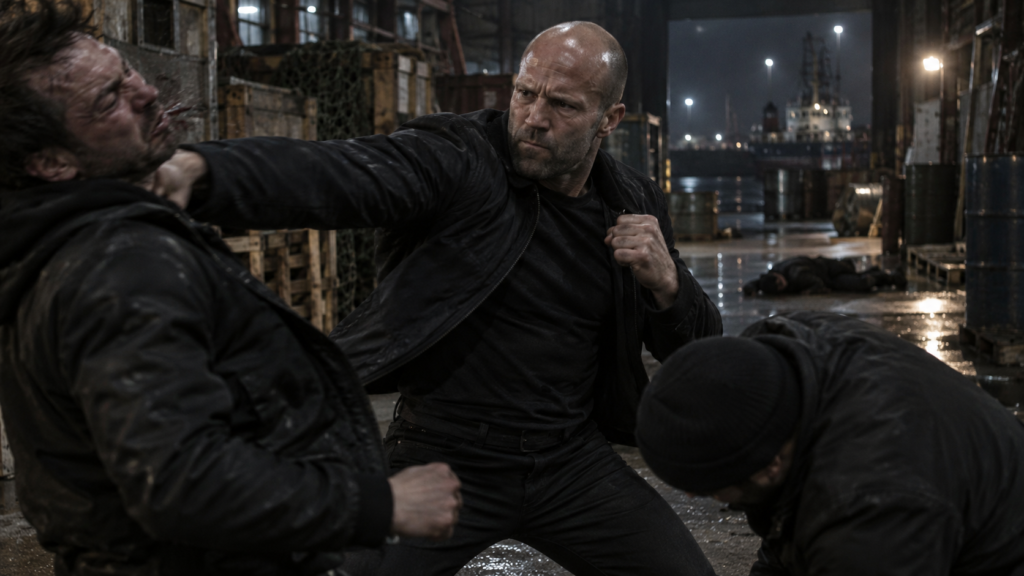
The frustrating part is that the physical side of the movie is perfectly watchable. Ric Roman Waugh began his career as a stunt performer, and Shelter generally favors grounded physical action rather than turning Statham into a superhero. There are car chases, hand-to-hand fights and several moments where Mason uses whatever happens to be around him as a weapon. Statham, as usual, looks completely at home in these scenes. He does not need much dialogue to sell the idea that this man knows exactly what he is doing. (moviefone.com)
The problem is that action becomes much more satisfying when the audience is emotionally ahead of the hero. You want the villain to lose. You want the hero to reach that final confrontation. You understand why the violence has become unavoidable. I did not always feel that in Shelter. At times, I found myself thinking less about how satisfying it was to watch Mason defeat another opponent and more about why those people were being sent after him in the first place.
The Villains Almost Become the Ones I Feel Sorry For
This may sound strange, but toward the end I occasionally felt more sympathy for the people being taken out by Mason than the movie probably intended. Not because they are particularly interesting characters—they are not—but because the story never made Mason’s enemies feel dangerous, hateful or personally meaningful enough to justify the satisfaction the action scenes seem to expect from the audience.
In a well-built revenge or protection thriller, every opponent represents part of the threat. Here, some of them feel more like employees who happened to receive a very bad assignment. That weakens the payoff. An action movie can survive a familiar story, clichés and even thin characters. What it struggles to survive is a conflict that leaves the audience asking, “Why is everyone doing this?” Once that question appears, every following fight scene has to work harder.
Is Shelter Worth Watching?
If you are a Jason Statham fan, probably yes. He still gives you what you came for, and he is convincing in the physical scenes. Shelter also gives him more room than usual to play a tired, isolated man gradually forming a bond with someone else, and that emotional element is probably the film’s strongest idea.
Audience reaction also suggests that many viewers are perfectly happy with what the movie offers. Rotten Tomatoes currently lists a 64% critics score but an 87% verified audience score, a fairly large gap that makes sense for this kind of star-driven action film. (rottentomatoes.com)
If you mainly want to watch Jason Statham quietly threaten people and then efficiently beat them up, Shelter does the job. But if you are not already a Statham fan, I would have a harder time recommending it. There are too many better examples of this exact kind of story.
Final Thoughts on Shelter
I do not think Shelter fails because it uses a familiar action formula. That formula still works. A highly capable protagonist, a painful past, someone worth protecting and a threat that forces him back into the fight—that is enough to make a great action movie.
But those pieces need to fit together. In Shelter, the hero works, the relationship at the center of the movie mostly works and the action often works. The part that never fully convinced me was the reason all of those things had to collide in the first place. Once that foundation feels weak, everything built on top of it feels slightly unstable.
So my recommendation is fairly simple. Jason Statham fans should give it a try. Everyone else can probably skip it. The movie has enough action to keep moving, but not enough story underneath it to make that movement feel completely earned.
Sometimes an action film does not need a better explosion. It just needs a better reason for the explosion to happen.