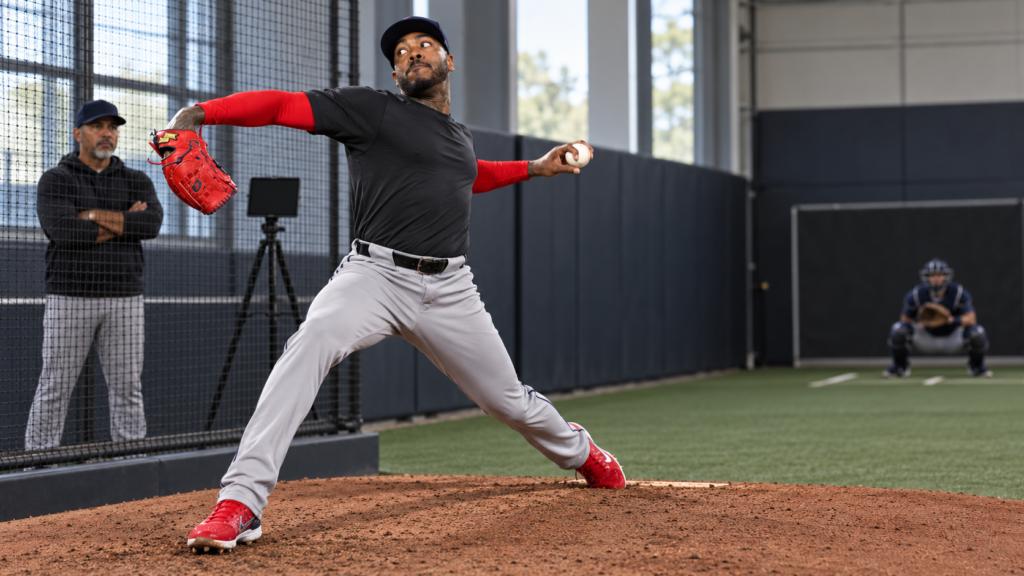
More Than Velocity: How Aroldis Chapman Revived His MLB Career
At 37, Aroldis Chapman produced one of the best seasons of his career. The Boston Red Sox closer finished 2025 with a 1.17 ERA, a 0.70 WHIP and 32 saves, then won the Mariano Rivera American League Reliever of the Year Award.
The performance was not a one-season anomaly. Through September 7, 2026, the 38-year-old had recorded a 2.03 ERA, a 1.13 WHIP, 65 strikeouts and 33 saves in 48⅔ innings. He was selected to his ninth All-Star Game and became only the ninth pitcher in MLB history to reach 400 career saves.
The obvious explanation is that Chapman could still throw 100 mph. But that is not the full story. His velocity and strikeout ability had already returned before he joined Boston. What changed in 2025 was his ability to repeat his delivery, throw his fastballs with specific intent and use two different high-velocity fastballs to control both sides of the plate.
Chapman’s late-career revival was built in two stages. Private pitching coach Héctor Berríos helped rebuild his lower-body movement, arm path and delivery after his decline with the New York Yankees. Then Boston’s catchers gave him a surprisingly simple way to turn those mechanical gains into better command: stop aiming generally at home plate and begin targeting specific locations. His continued success in 2026 suggests that these changes created a sustainable new version of Chapman rather than a brief return to form.
In short: Chapman did not revive his career by finding more velocity. He learned to repeat his delivery, give every fastball a specific destination and use the elite velocity he still had more effectively.
Why did Aroldis Chapman need to reinvent himself?
By the end of 2022, Chapman appeared to be approaching the end of his time as an elite reliever. He posted a 4.46 ERA in his final season with the Yankees, struggled to command his fastball and was left off the club’s postseason roster.
His raw ability had not disappeared, but the margin for error had narrowed. When Chapman was younger, hitters could know a four-seam fastball was coming and still fail to catch up. As his velocity declined slightly and his delivery became less consistent, the same approach became far less reliable.
His stuff began to recover in 2023 with the Kansas City Royals and Texas Rangers. The velocity returned, his strikeout rate climbed above 40% and he helped Texas win the World Series. But one major problem remained: walks.
That issue peaked again with the Pittsburgh Pirates in 2024. Chapman still missed bats at an elite rate, but walked more than 14% of the hitters he faced. His walk rate in plate appearances ending with a four-seam fastball reached 29%, while the figure on plate appearances ending with a slider was 19%.
This distinction matters. Chapman did not arrive in Boston needing to recover his arm strength. He needed to control the elite stuff he already had.
Who helped fix Aroldis Chapman’s pitching mechanics?
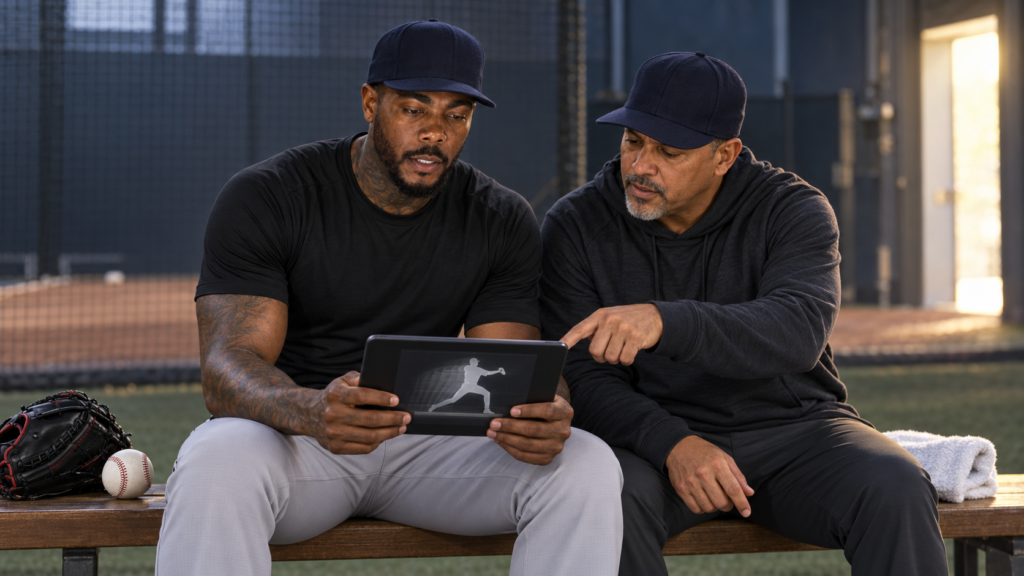
Chapman worked privately with veteran pitching coach Héctor Berríos, a Puerto Rican coach with professional baseball experience. Their work began before Chapman’s 2023 rebound and continued into the offseason preceding his 2025 debut with Boston.
Berríos later described the process in a long-form interview on The Tread Podcast. The episode was titled “The Coach Who Helped Fix Aroldis Chapman & How He Did It.” This does not mean Chapman was a Tread Athletics athlete; Berríos was the coach who worked with him directly, while Tread hosted the interview.
The mechanical rebuild focused on four connected areas: loading the back leg, creating a deeper hip hinge, allowing the pelvis to lead the delivery and reconnecting the arm path to the rest of the body.
1. Loading the back leg
Berríos wanted Chapman to coil into his back leg and store force before moving toward the plate. When a pitcher drifts forward too early, the pelvis, torso and throwing arm can fall out of sequence. For a pitcher with Chapman’s arm speed, even a small timing error can produce a large miss.
By learning to hold pressure in the back hip and leg, Chapman created a more stable starting point for the rest of his delivery.
2. Creating a deeper hip hinge
Chapman also worked on a deeper hip hinge—the movement created when the hips move backward while the torso stays controlled. This allowed him to use his glutes and lower body more effectively instead of generating velocity primarily with his upper body and arm.
The purpose was not merely to throw harder. A deeper and more stable hinge helped him move down the mound without opening his upper body too early.
3. Letting the pelvis lead the delivery
Berríos emphasized that the pelvis should drive the movement of the lead leg and knee. The intended sequence was back-leg load, pelvic movement, front-foot landing, torso rotation and finally arm acceleration.
When those movements occurred in the correct order, Chapman could transfer force from the ground through his body instead of trying to manufacture velocity with his arm alone.
4. Reconnecting the arm path to the body
Chapman’s arm path was also addressed. If the lower body moves forward while the throwing arm stays behind, the upper body can open early and the release point becomes difficult to repeat. Berríos used drills—including towel work—to connect the arm more consistently to the movement of the pelvis and torso.
The larger concept was what Berríos called throwing “hard, easy.” Chapman did not need to force every pitch at maximum effort. With an efficient kinetic sequence, he could feel as if he were throwing 95 or 96 mph while still producing elite velocity.
The pair continued working together in Miami before the 2025 season, focusing on physical preparation, delivery maintenance and fastball work. This was not a one-time mechanical fix. It became an offseason process built around repeatable mechanical anchors.
How did a PitchCom cue improve Chapman’s command?
The mechanical work helped restore Chapman’s stuff, but it does not fully explain why his walk rate was cut roughly in half in 2025. A second adjustment came during Boston’s spring training—and it was remarkably simple.
According to a story reported by ESPN’s Buster Olney, catcher Connor Wong used PitchCom to call an “inside fastball” while catching Chapman. That level of location was apparently more specific than the instructions Chapman had often received during his career. With his extraordinary velocity, catchers had frequently asked for a fastball without demanding a precise target.
The cue encouraged Chapman to stop throwing his fastball generally toward the plate and begin committing to a defined location: inside, outside or elevated.
Red Sox catcher Carlos Narváez later confirmed the substance of the story. He explained that Chapman began locating his fastball inside when he wanted it inside and away when he wanted it away. More importantly, every pitch now had a clear purpose. Sports Illustrated’s account of the PitchCom adjustment
The PitchCom moment did not rebuild Chapman’s delivery; Berríos had already done much of that work. What it appears to have changed was his intent.
This is the pitching version of “aim small, miss small.” A pitcher aiming only for the strike zone can miss in any direction. A pitcher targeting the catcher’s glove at the upper-inside edge may still miss, but the miss is more likely to remain competitive.
The statistical change was dramatic:
| Command metric | 2024 | 2025 |
|---|---|---|
| Overall walk rate | About 14% | About 7% |
| Plate appearances in which Chapman worked ahead | 31% | 40% |
| Plate appearances reaching a three-ball count | 27% | 14% |
The change was not simply that more pitches landed in the strike zone. Chapman reached favorable counts more often, gave hitters fewer opportunities to wait for a walk and created better conditions for his slider and splitter to generate chases.
Chapman did not suddenly become a finesse pitcher. He became a power pitcher with precise intentions.
How did Chapman change his pitch mix?
Improved mechanics and clearer targets would have had less value if Chapman had continued relying almost entirely on one fastball.
From 2010 through 2017, Chapman threw his four-seam fastball approximately 80% of the time. In 2025, his arsenal was far more balanced:
| Pitch | 2025 usage | Primary purpose |
|---|---|---|
| Four-seam fastball | 40% | Elevated velocity and swing-and-miss |
| Sinker | 34% | Arm-side movement and opposite-side fastball command |
| Slider | 15% | Breaking-ball put-away pitch |
| Splitter | 11% | Vertical separation, particularly against right-handed hitters |
The sinker was especially important. Chapman could now attack hitters with two fastballs traveling at nearly the same elite velocity but moving differently.
Against right-handed hitters, he could elevate the four-seamer inside and run the sinker toward the outer part of the plate. Against left-handed hitters, he could reverse the pattern, using the four-seamer away and the sinker on their hands.
That changed the hitter’s decision. The question was no longer simply “fastball or breaking ball?” A hitter also had to distinguish between two triple-digit fastballs moving toward different locations, while still protecting against a slider and splitter.
The four-seamer no longer had to do everything.
Did Chapman’s revival hold up in 2026?
Chapman’s final season line was exceptional: a 1.17 ERA, 0.70 WHIP, .131 opponent batting average and 32 saves in 61⅓ innings. Among pitchers with at least 50 innings, he led MLB in ERA, WHIP, opponent batting average, opponent on-base percentage, opponent slugging percentage and opponent OPS.
He also made 17 consecutive hitless appearances from July 26 through September 7. Across that span, he recorded 12 saves, struck out 21 hitters and allowed only four walks in 14⅔ innings. He did not allow more than one run in any of his 67 appearances. The season earned him the 2025 Mariano Rivera American League Reliever of the Year Award.
A 1.17 ERA inevitably contains some favorable variance, particularly for a reliever working just over 60 innings. But the foundation of the improvement was measurable. Chapman maintained an elite strikeout rate while eliminating roughly half his walks, getting ahead more often and making his fastballs significantly more effective without adding meaningful velocity.
His 2026 performance provided a more meaningful test of whether those gains would last. Through September 7, Chapman had appeared in 50 games and posted the following numbers:
| 2026 statistic | Result through September 7 |
|---|---|
| Innings pitched | 48⅔ |
| ERA | 2.03 |
| WHIP | 1.13 |
| Strikeouts | 65 |
| Strikeout rate | 32.3% |
| Walk rate | 10.0% |
| Saves | 33 in 35 opportunities |
The control was not quite as exceptional as it had been in 2025: his walk rate rose from approximately 7% to 10%. Yet it remained substantially better than the 14%-plus rate that undermined his 2024 season, while his strikeout rate stayed elite. A 2.03 ERA and 33 saves showed that the underlying reinvention was still working even after some natural regression from his career-best year.
Chapman also reached two major career milestones in 2026. On July 4, he recorded his 1,364th strikeout as a reliever, moving past Hoyt Wilhelm for the most in MLB history. On September 6, he converted his 33rd save of the season and the 400th of his career, becoming only the ninth pitcher to reach that total. His performance also caused a $13 million option for 2027 to vest, subject to his end-of-season physical. Chapman’s 400th save and 2026 statistics
That is why Chapman’s success should be viewed as a genuine reinvention rather than a lucky run. The 2025 season represented the peak, but the 2026 follow-up demonstrated that the changes were durable enough to keep him among MLB’s most effective closers at age 38.
What is the real lesson from Chapman’s revival?
Chapman did not simply turn back the clock. The 37-year-old version became a more complete pitcher than the younger version had ever needed to be.
His younger self could overpower hitters with one extraordinary pitch. His older self needed a repeatable lower-body sequence, a connected arm path, specific location targets and four pitches that reinforced one another.
The most important lesson is that technology and coaching worked together—but neither required a dramatic reinvention on its own. Berríos gave Chapman a delivery he could repeat. PitchCom gave each pitch a precise destination. A more balanced arsenal gave hitters several different movements to process at elite velocity. His 2026 results show that those adjustments continued to work even when his command regressed slightly from its extraordinary 2025 level.
Chapman’s revival was not built on finding more velocity. It was built on learning how to use the velocity he still had.
Frequently Asked Questions About Aroldis Chapman’s Career Revival
Did Aroldis Chapman train at Driveline Baseball or Tread Athletics?
There is no reliable public evidence that Chapman trained at Driveline Baseball. He worked directly with private pitching coach Héctor Berríos. Berríos later discussed their work on Tread Athletics’ podcast, but that interview does not establish that Chapman trained at Tread.
Who is Héctor Berríos?
Héctor Berríos is an experienced Puerto Rican pitching coach who worked privately with Chapman on lower-body movement, hip rotation, balance, arm path and repeatable delivery mechanics. Their work preceded Chapman’s 2023 rebound and continued before the 2025 season.
What was the biggest change in Chapman’s 2025 season?
The largest measurable change was command. His walk rate fell from approximately 14% to 7%, while his strikeout rate remained around 37%. He also reached fewer three-ball counts and worked ahead of hitters more frequently.
How is Aroldis Chapman performing in 2026?
Through September 7, 2026, Chapman had a 2.03 ERA, a 1.13 WHIP, 65 strikeouts and 33 saves in 48⅔ innings. He converted 33 of 35 save opportunities, earned his ninth All-Star selection and became the ninth pitcher in MLB history to record 400 career saves.
Did Chapman add a new pitch in 2025?
No single new pitch explains the turnaround. The important change was how he used his existing arsenal. He threw a career-high share of sinkers and paired them with four-seam fastballs, sliders and splitters to attack different locations and create multiple movement profiles.
Was PitchCom responsible for Chapman’s revival?
PitchCom was part of the story, not the entire explanation. A specific location cue reportedly helped Chapman commit to smaller fastball targets, but the mechanical foundation had already been rebuilt through his work with Berríos. The revival came from the combination of repeatable mechanics, clearer intent and a more balanced pitch mix.