Electricity Alone Will Not Win the AI Race
The decisive advantage will come from converting power into productive compute—and productive compute into measurable economic value.
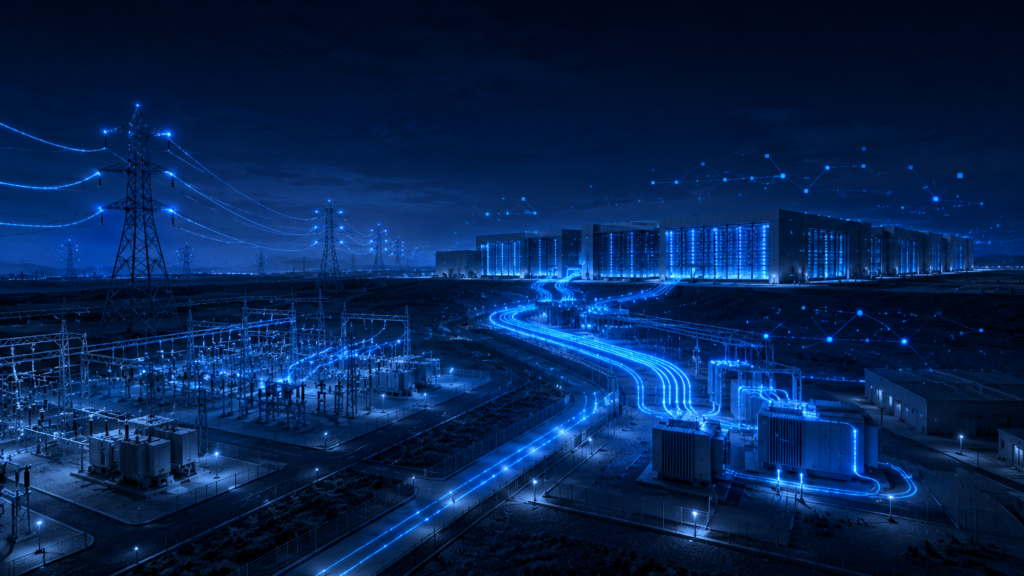
The global AI competition is increasingly framed as an energy race. The logic is understandable: advanced AI requires large data centers, and those facilities require accelerators, cooling systems, networks, and enormous amounts of electricity.
But national power generation and corporate electricity contracts do not translate automatically into AI capability.
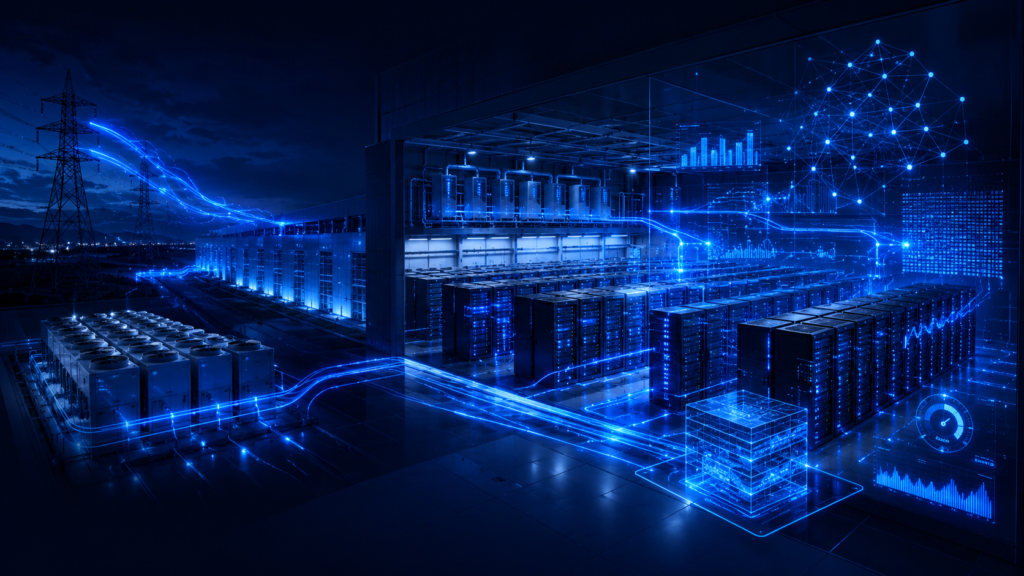
Electricity must reach the right location. A data center must connect to the grid, obtain transformers and switchgear, secure chips and networking equipment, operate its computing fleet efficiently, and turn that capacity into outcomes that justify the investment.
The more useful question is therefore not:
Who can secure the most electricity?
It is:
Who can convert electricity into productive compute—and productive compute into economic value—with the least delay, waste, and operational friction?
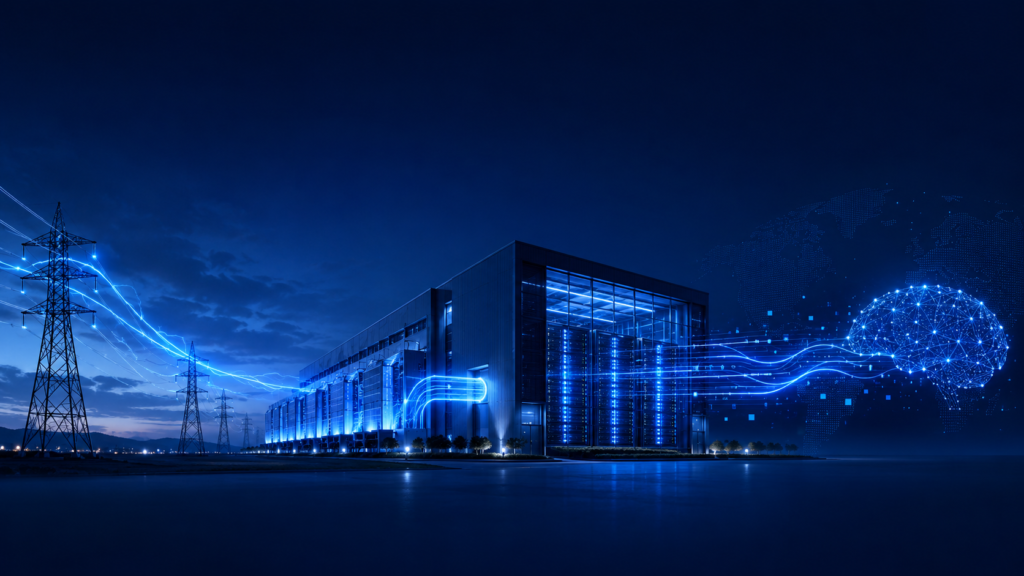
The Cha Signal uses a five-stage framework to examine that conversion:
Energy → Grid Access → Compute → Utilization → Economic Output
A constraint at any stage reduces the value of everything that comes before it.
Key Takeaways
- Global data-center electricity consumption is projected to roughly double by 2030, with AI the largest driver of growth.
- Electricity generation is only the first stage of AI infrastructure competitiveness. Grid connection speed, hardware access, operational efficiency, and business adoption matter as much as raw power availability.
- Time to power may be more strategically important in the near term than a country’s theoretical electricity surplus.
- GPU ownership is not the same as GPU productivity. The more useful long-term question is how much verified AI value an organization produces from each unit of energy and computing capacity.
- AI agents could intensify demand because one completed business task may require several model calls, tool executions, validations, and retries.
AI Electricity Demand Is Rising—But the Headline Can Mislead
The pressure on power systems is real.
The International Energy Agency reported that global data-center electricity demand rose by 17% in 2025, compared with approximately 3% growth in total global electricity demand. AI-focused facilities grew faster still.
The IEA’s updated central outlook projects data-center electricity consumption rising from about 485 terawatt-hours in 2025 to roughly 950 TWh in 2030, accounting for around 3% of global electricity demand. AI-focused data centers are expected to grow much faster than the broader category.
The United States illustrates the local impact more clearly. Lawrence Berkeley National Laboratory’s 2025 update estimates that data centers could account for 11.8% of total U.S. electricity consumption in 2030, with a modeled range of 9.5% to 15.3%.
These figures should not be treated as precise forecasts. Actual demand will depend on model efficiency, hardware design, utilization, construction delays, energy prices, financing conditions, and the workloads that ultimately scale.
Still, the direction is clear: AI is becoming an important source of electricity demand, and the resulting pressure will be geographically concentrated. That concentration is what makes the infrastructure problem more difficult than the global percentages suggest.
The Wrong Question: Who Has the Most Electricity?
National electricity generation is a poor proxy for near-term AI deployment capacity.
A large data center needs power in a particular region, at a particular voltage, with sufficient reliability, and within a commercially useful timeline. Before the first GPU can perform useful work, the project may require:
- transmission and distribution capacity,
- an approved grid connection,
- substations and transformers,
- switchgear and backup systems,
- cooling and water infrastructure,
- high-speed network connections,
- permits and construction capacity,
- and qualified operators.
A country can therefore possess abundant energy resources while individual AI projects remain stalled by local grid constraints.
This creates a structural mismatch. AI chips, models, and software improve on timelines measured in months. Transmission projects, substations, generation assets, and regulatory approvals often move on multiyear timelines.
The IEA estimates that roughly 20% of planned data-center projects could face delays unless grid-integration risks are addressed. A company may secure GPUs before it can secure the power connection needed to run them.
The relevant advantage is not simply power availability. It is time to power: how quickly a viable site can receive dependable electricity at the scale required.
The AI Infrastructure Conversion Chain
The following framework separates AI infrastructure competitiveness into five stages.
| Stage | Core question | Typical bottlenecks | Illustrative measures |
|---|---|---|---|
| 1. Energy | Can enough dependable electricity be generated? | Generation capacity, price, reliability, fuel availability | Available MW, power price, outage frequency |
| 2. Grid Access | Can that electricity reach the required site in time? | Interconnection queues, transmission, transformers, permits | Time to power, connection lead time |
| 3. Compute | Can delivered power be converted into usable AI capacity? | Chips, networking, cooling, storage, facilities, talent | Available accelerator capacity, cluster readiness |
| 4. Utilization | Is installed capacity doing useful work efficiently? | Idle reservations, scheduling, failed jobs, poor model selection | Utilization, cost per workload, failure rate |
| 5. Economic Output | Does the compute create measurable value? | Weak use cases, poor workflow integration, low adoption | Verified tasks, time saved, revenue, cost reduction |
1. Energy
The first requirement is sufficient and dependable electricity generation.
Relevant factors include generation capacity, price, reliability, fuel diversity, carbon intensity, and the ability to add supply. Countries with abundant natural gas, renewable resources, nuclear capacity, or other dependable energy sources may possess a structural advantage.
But generation is only the starting point. Electricity that cannot reach a viable data-center location has limited near-term strategic value.
2. Grid Access
Grid access determines whether theoretical energy resources become usable infrastructure.
This stage includes transmission capacity, local distribution networks, interconnection queues, transformer supply, permitting, substation construction, and system reliability.
It may be the most underestimated link in the chain. A region can possess low-cost electricity and still be unattractive for near-term AI deployment if connection lead times are too long or network capacity is located far from suitable sites.
For the next several years, connection speed may matter more than aggregate national power generation.
3. Compute
Delivered electricity must then be converted into usable computing capacity.
That requires more than buying GPUs. The complete layer includes accelerators, servers, high-speed networking, storage, cooling, data-center facilities, orchestration software, security controls, and skilled personnel.
Hardware without supporting infrastructure has limited productive value. A country with abundant power but restricted access to advanced accelerators may struggle to build frontier capacity. A company with expensive GPUs but inadequate networking, cooling, or software architecture may experience a similar failure at a smaller scale.
4. Utilization
Installed capacity must be scheduled and operated efficiently.
GPU ownership is not equivalent to GPU productivity. Underutilization can result from:
- idle reservations,
- fragmented development environments,
- poor workload scheduling,
- oversized models,
- inefficient inference,
- data bottlenecks,
- failed training jobs,
- duplicated resources,
- and limited sharing across teams.
A large GPU fleet can remain technically impressive while generating relatively little useful output.
Energy consumption per AI task continues to decline as hardware and models become more efficient. Yet lower unit costs can be offset by broader adoption, more complex workloads, and higher task volumes—including agentic workflows.
Infrastructure competitiveness should therefore be evaluated by both installed capacity and the amount of useful work performed.
5. Economic Output
The final stage is the conversion of computation into measurable value.
That value may take the form of higher productivity, new revenue, lower operating costs, scientific discoveries, improved public services, better products, or defensible intellectual property.
This is where an infrastructure race becomes an economic competition.
A company can operate a large cluster at high utilization and still produce a poor return if workloads are disconnected from valuable business processes. A country can attract data-center investment without capturing much of the downstream value if technology ownership, intellectual property, skilled employment, and domestic access remain limited.
Maximum computation is not the objective. The objective is to generate the greatest verified value from the resources consumed.
A Better Analytical Lens: Useful AI Output per Megawatt
The AI industry often emphasizes input and capability metrics:
- GPU count,
- model size,
- training speed,
- total compute capacity,
- data-center megawatts,
- and capital expenditure.
These measures are necessary, but they do not reveal whether the infrastructure produces valuable outcomes.
The Cha Signal proposes a complementary analytical category:
Useful AI Output per Megawatt
This is not a universal industry standard or a single cross-sector formula. It is a family of productivity measures that should be defined for each workload and organization.
For an enterprise AI agent, one possible measure is:
Verified business tasks completed ÷ MWh consumed
Other enterprise measures could include employee hours saved, incidents resolved, customer cases completed, or measurable operating costs avoided.
For an AI research cluster, the relevant output could be successful experiments, model improvements, or scientific discoveries. For a public-sector system, it could be processing time reduced, service accuracy improved, or administrative cost avoided.
The principle is straightforward:
AI infrastructure should be evaluated by the verified value it produces—not only by the energy and hardware it consumes.
Two organizations may operate facilities with similar power capacity. The one with better data, models, scheduling, software, and workflow design can produce substantially more economic value from the same electricity input.
That difference is a genuine competitive advantage.
Why AI Agents Could Intensify the Conversion Problem
Agentic AI makes this framework more important because a single business outcome may require a long sequence of computational actions.
A conventional interaction may resemble:
Prompt → Model response
An agentic workflow may involve:
Goal → Planning → Retrieval → Model call → Tool execution → Validation → Retry → Additional model call → Final action
One completed task can therefore require multiple inferences, database queries, application calls, and verification steps.
The critical metric is not merely how many tokens an agent generates. It is:
How much computation does the system require to produce one verified outcome?
An agent may remain busy while failing to complete its assigned task. From an infrastructure perspective, it has consumed compute. From a business perspective, it may have produced no useful result.
Enterprise evaluation will increasingly need to connect technical and economic measures, including:
- compute consumed per completed task,
- model calls per successful outcome,
- retry and tool-failure rates,
- latency,
- human intervention rates,
- and cost per verified result.
An efficient agent is not simply one that responds quickly. It is one that reaches a reliable outcome with an economically reasonable amount of computation.
Efficiency Will Improve—But Total Demand May Still Rise
AI hardware, models, and operating systems will continue to improve.
More efficient accelerators can process additional workloads per watt. Quantization, compression, routing, and specialized models can reduce computing requirements. Better cooling and power management can lower facility overhead.
The IEA expects renewables to meet nearly half of the growth in global data-center electricity demand between 2024 and 2030, while efficiency improvements reduce consumption relative to less efficient scenarios.
But efficiency does not guarantee falling total demand.
When inference becomes cheaper:
- AI features can be added to more products,
- more employees can use AI continuously,
- agents can execute longer workflows,
- and previously uneconomic use cases can become viable.
The electricity required for one task may decline while the total number of tasks grows faster. This rebound effect changes the strategic value of efficiency.
Efficiency matters not only because it can reduce power consumption. It enables organizations to produce more useful AI output from a constrained supply of energy and computing capacity.

Where Value Accumulates as Bottlenecks Move
The demand for productive compute creates opportunities beyond power generation and semiconductor manufacturing.
Potentially important layers include:
- transmission equipment,
- transformers and switchgear,
- grid-management software,
- data-center cooling,
- high-speed networking,
- workload orchestration,
- GPU scheduling,
- power-efficient semiconductors,
- energy storage,
- and AI performance monitoring.
Value is likely to accumulate around the stage that constrains the conversion chain at a given moment.
When accelerators are scarce, chip suppliers gain leverage. When electricity exists but connections are delayed, transmission equipment and interconnection capabilities become more valuable. When GPU fleets expand but utilization remains low, orchestration and infrastructure-management software become more important.
However, exposure to a bottleneck does not automatically produce attractive returns. Competitive intensity, capital requirements, execution quality, pricing power, and valuation determine which companies capture the economic value.
Investors and policymakers should therefore ask not only how quickly AI demand is growing, but where the conversion process is constrained—and who can relieve that constraint profitably.
The Risk of Building Capacity Without Productivity
The scale of announced data-center investment also creates a risk of overbuilding and misallocated capital.
Developers may request power in several locations before selecting a final site, causing utility project pipelines to overstate eventual demand. Capacity may also be constructed on assumptions about AI adoption that do not materialize, or that are partly offset by faster efficiency gains.
Even a completed and highly utilized data center does not automatically represent high economic productivity. A system can remain technically busy while producing low-value output.
Governments evaluating large projects should therefore look beyond headline investment figures and ask:
- Who pays for grid upgrades?
- How many permanent jobs will be created?
- Who owns the computing infrastructure?
- Will domestic organizations gain meaningful access?
- Where will intellectual property be created?
- How much water and land will be required?
- Can the facility reduce demand during grid stress?
- What economic output is expected relative to the energy consumed?
Large electricity consumption is not evidence of technological leadership by itself.
The Cha Signal View
AI is becoming constrained by energy, but electricity alone will not determine the winners.
The more strategic resource is productive compute: capacity that is connected, available, efficiently utilized, and capable of generating measurable value.
The five-stage conversion chain provides a more complete test:
- Can sufficient energy be generated?
- Can it reach the required site quickly?
- Can it be converted into advanced computing capacity?
- Can that capacity be used efficiently?
- Can the resulting computation create defensible economic value?
In the near term, grid connection speed may matter more than theoretical energy abundance. Over time, utilization and economic output may matter more than the number of GPUs installed.
The countries and companies that outperform may not operate the largest data centers or consume the most electricity. They may be the ones that produce the most useful AI output from every megawatt they can secure.
Frequently Asked Questions
Is electricity becoming the main bottleneck for AI?
Electricity is becoming an important constraint, but the practical bottleneck is often the ability to deliver dependable power to a specific data-center site within the required timeline. Grid access, transformers, permits, cooling, chips, and networking can all delay deployment.
What is productive compute?
Productive compute is computing capacity that is available, efficiently utilized, and connected to outcomes with measurable technical, social, or economic value.
Is “Useful AI Output per Megawatt” an official industry metric?
No. It is a The Cha Signal analytical framework. The specific numerator should be defined by workload—for example, verified tasks completed, operating costs avoided, or research outcomes achieved.
Will more efficient AI models reduce total electricity use?
They can reduce electricity use per task. Total consumption may still increase if lower costs lead to wider adoption, more tasks, and more complex agentic workflows.
Sources and Further Reading
- International Energy Agency, Key Questions on Energy and AI
- International Energy Agency, Energy and AI
- International Energy Agency, Electricity 2026
- Lawrence Berkeley National Laboratory, United States Data Center Energy Usage Report: 2025 Update
- U.S. Department of Energy, materials on powering AI and data-center infrastructure
About The Cha Signal
The Cha Signal examines structural shifts in AI, semiconductors, energy, and global business. Articles are developed through primary-source research, cross-source verification, and independent editorial analysis.
AI tools may assist with research organization, outlining, and language editing. Source selection, factual verification, analysis, and final editorial judgment remain under human responsibility.
This article is provided for informational and educational purposes only. It does not constitute investment, financial, legal, or professional advice.