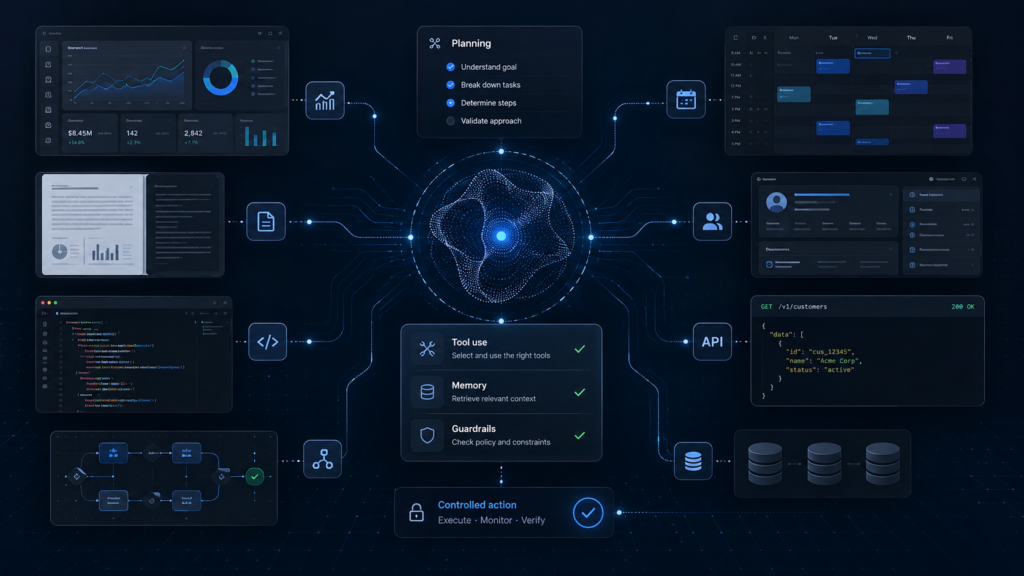
AI Agents Explained: What They Can Actually Do—and Where They Still Fall Short
Artificial intelligence is beginning to move beyond generating answers.
A generative AI tool can summarize a report, draft an email, or explain how to complete a task. An AI agent is designed to go further. It can interpret a goal, decide what steps are needed, connect to external systems, and take actions on behalf of a user.
That distinction sounds simple. In practice, it changes the role AI can play inside an organization.
An AI system that only produces text remains an assistant. A system that can access data, use tools, update business applications, and respond to the outcome of its own actions becomes part of an operational process.
This is why AI agents have attracted so much attention. It is also why the term is frequently overstated.
Not every chatbot is an agent. Not every workflow becomes better when an agent is added. And a system that appears autonomous in a controlled demonstration may still be unreliable in a real business environment.
The more useful question is not whether AI agents are impressive.
It is whether they can complete a defined task accurately, safely, and at an acceptable cost.
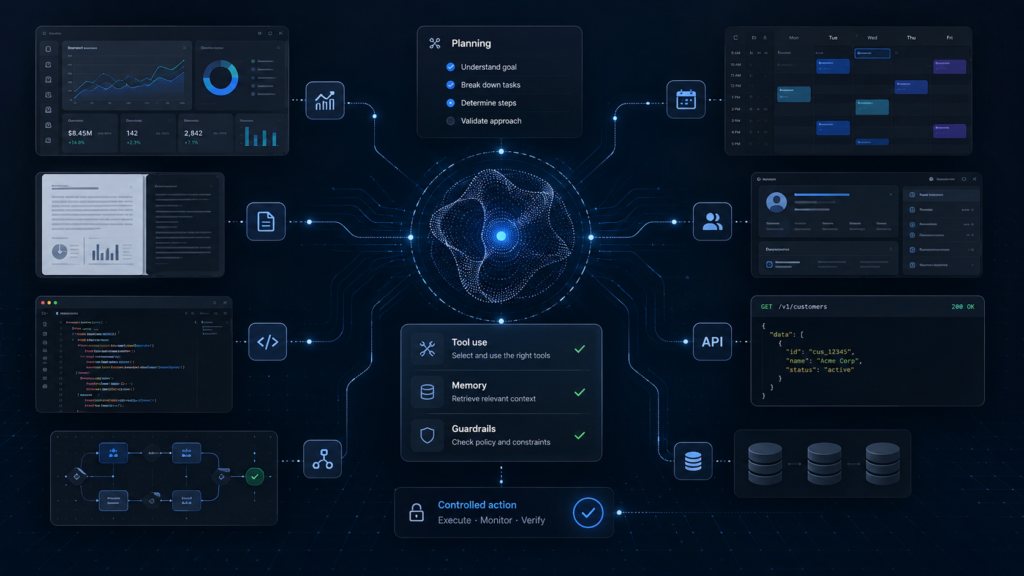
Key Takeaways
- An AI agent is a goal-oriented software system that can plan, use tools, and take actions within defined boundaries.
- A large language model may provide the reasoning layer, but the model alone is not the agent.
- The real value of an agent depends on task completion, not on how natural or intelligent its responses appear.
- Tools, data access, permissions, memory, monitoring, and human oversight are as important as model quality.
- AI agents are most useful when a task requires interpretation and adaptation. Fixed, predictable processes may still be better handled by conventional automation.
- As agents become more autonomous, security, cost, evaluation, and governance become harder—not easier.
What Is an AI Agent?
An AI agent is a software system that works toward a goal and takes actions on behalf of a user or organization.
The user does not always need to describe every individual step. Instead, the user defines an objective, and the agent determines how to approach it using the information, tools, and permissions available to it.
Consider a business trip.
A conventional AI assistant might produce a suggested itinerary.
An AI agent could potentially:
- Check the traveler’s calendar.
- Search available flights.
- Compare prices with company travel policies.
- Recommend suitable options.
- Request approval.
- Make a reservation.
- Add the confirmed trip to the calendar.
The important difference is not that the agent writes a better answer.
It is that the system can move from language to action.
That ability depends on more than a language model. A functioning agent also needs access to tools, relevant data, workflow rules, permissions, and some way to evaluate whether the task was completed correctly.
AI Agents and Generative AI Are Not the Same
Generative AI and AI agents are closely related, but they serve different purposes.
Generative AI is primarily designed to create content in response to a prompt. An AI agent uses AI models as part of a larger system that can pursue an objective and interact with an external environment.
| Capability | Generative AI | AI Agent |
|---|---|---|
| Primary purpose | Generate content | Complete a goal-oriented task |
| Typical input | Prompt | Objective or assignment |
| Typical output | Text, image, code, or summary | Action, decision, or completed workflow |
| Tool use | Optional | Usually central |
| Planning | Often limited to the prompt | Can break a goal into multiple steps |
| Memory | Usually session-based | May retain task or user context |
| External systems | Limited or manual | Can connect to APIs, applications, and databases |
| Autonomy | Low to moderate | Ranges from assistive to autonomous |
A generative AI model might explain how to prepare an expense report.
An expense-management agent could retrieve receipts, classify expenses, identify missing information, complete the report, and submit it for approval.
This does not mean the agent is independently intelligent in the human sense. It means the system has been given enough context and access to perform a sequence of operations.
That distinction matters because the risks also change.
A chatbot that produces an incorrect sentence creates one type of problem. An agent that updates a customer record, sends an email, or initiates a transaction can create a much larger one.
How Do AI Agents Work?
Most AI agents can be understood through six connected elements.
1. A Defined Goal
Every agent begins with an objective.
A simple goal might be:
Summarize today’s customer complaints.
A more complex goal could be:
Identify recurring product issues, determine which customer groups are most affected, and prepare a prioritized response plan.
The quality of the goal matters.
A vague objective gives the agent more room to interpret what the user intended. That flexibility can be useful, but it can also lead the system in the wrong direction.
In enterprise environments, agents generally perform better when their scope, users, available tools, and stopping conditions are clearly defined.
2. Reasoning and Planning
The agent determines what steps are required to complete the task.
For a complex objective, it may:
- collect relevant information,
- compare available options,
- select a tool,
- perform an action,
- inspect the result,
- and decide whether another step is necessary.
The word “reasoning” can make this process sound more human than it is.
In practice, the agent is generating and evaluating possible next steps based on its instructions, model behavior, available context, and previous outputs. The process can be useful and flexible, but it remains probabilistic.
An agent may choose a sensible plan. It may also misunderstand the objective, skip an important check, or continue down an incorrect path with considerable confidence.
3. Tools
Tools allow an agent to do more than generate a response.
They may include:
- web search,
- internal databases,
- business applications,
- email and calendar systems,
- CRM platforms,
- document repositories,
- code execution environments,
- payment systems,
- monitoring platforms,
- or physical devices.
Without tools, an AI system can usually explain what should be done.
With tools, it can begin to do the work.
This is also the point at which security becomes more important. Every additional tool gives the agent more capability, but also expands the number of actions that must be controlled, monitored, and audited.
4. Knowledge and Business Context
An enterprise agent needs access to information that is relevant to the organization.
This may include:
- internal policies,
- product documentation,
- customer records,
- contracts,
- operational data,
- historical incidents,
- approved knowledge bases,
- and role-specific procedures.
Retrieval-augmented generation, commonly known as RAG, is often used to provide access to current or proprietary information.
However, connecting an agent to internal documents does not automatically make it reliable. The system still needs to retrieve the right information, interpret it correctly, and distinguish between authoritative and outdated sources.
Poor data quality can undermine even a strong model.
5. Memory
Memory helps an agent retain context across steps or interactions.
Short-term memory may track what has already happened during the current task.
Long-term memory may preserve user preferences, previous decisions, or recurring organizational knowledge.
Memory can improve continuity, but it introduces difficult questions:
- What information should be stored?
- How long should it remain available?
- Who is allowed to access it?
- Can incorrect information be corrected?
- Should sensitive information be remembered at all?
Memory is therefore not only a product feature. It is also a data-governance decision.
6. Evaluation and Feedback
After taking an action, an agent may evaluate whether the result satisfies the original goal.
It may then:
- continue to the next step,
- revise the plan,
- retry a failed action,
- choose another tool,
- request human input,
- or stop the workflow.
This feedback loop makes agents more adaptable than conventional rule-based automation.
It also makes them harder to test.
A fixed workflow usually follows the same sequence every time. An agent may choose different paths depending on the wording of the request, the information retrieved, or the result returned by an external tool.
The final answer alone is therefore not enough to evaluate performance. Organizations also need visibility into how the outcome was produced.
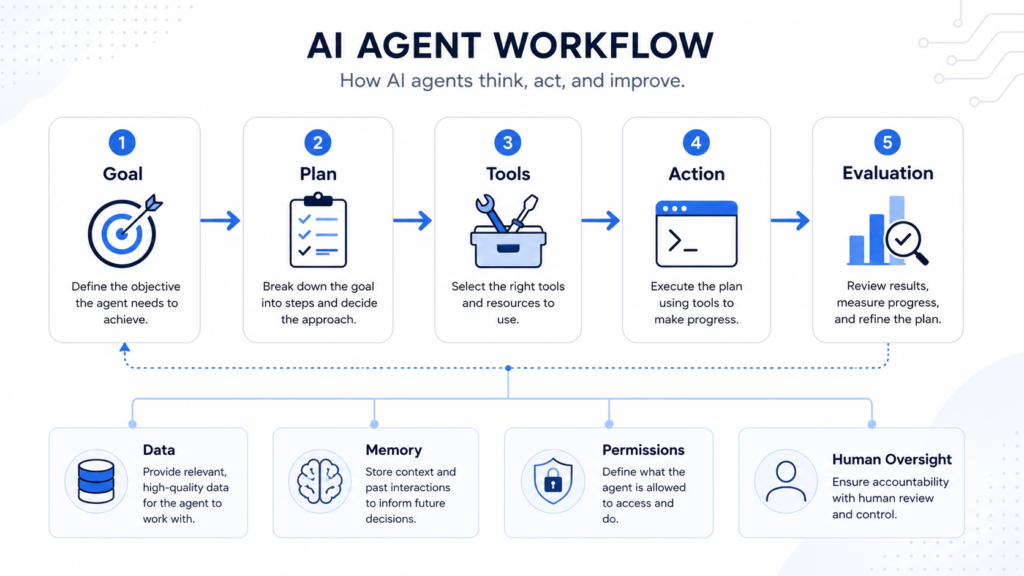
A Simple AI Agent Workflow
A typical AI agent follows a cycle similar to this:
Goal → Understand → Plan → Use Tools → Take Action → Evaluate → Continue or Stop
Consider an IT operations agent responding to a service incident.
It could:
- Receive an alert.
- Retrieve monitoring data.
- Review recent configuration changes.
- Compare the incident with previous cases.
- Identify the most likely cause.
- Recommend or execute an approved response.
- Verify whether performance has recovered.
- Record the action and result.
Traditional automation could handle several parts of this process.
The difference is that an agent may be able to interpret unstructured information, adapt its next action, and respond to an unexpected result.
That flexibility is valuable when the situation cannot be described entirely through predefined rules.
It is less valuable when the process must be perfectly predictable.
The Main Types of AI Agents
AI agents can be classified in many ways, but the most useful distinction for businesses is often the degree of autonomy.
Assistive Agents
Assistive agents analyze information and provide recommendations, while a person remains responsible for the final decision and action.
Examples include:
- research assistants,
- document-analysis agents,
- coding assistants,
- and decision-support systems.
This model is relatively easy to control because the human user remains inside the process.
It is also a practical starting point for many organizations. The agent can reduce research and preparation time without being given permission to make high-impact changes.
Human-in-the-Loop Agents
These agents perform parts of a workflow but require approval at specific points.
For example, an agent may review a supplier contract, identify risky clauses, and prepare suggested revisions. A legal professional must still approve the final version.
Human approval does not eliminate every risk. A reviewer may approve a recommendation without examining it closely.
Even so, approval checkpoints can prevent the agent from taking irreversible or sensitive actions without oversight.
For regulated industries, this may become the most realistic operating model.
Autonomous Agents
Autonomous agents can complete approved tasks without requesting permission at every step.
Potential examples include:
- resolving low-risk IT incidents,
- updating inventory records,
- scheduling routine appointments,
- or adjusting campaigns within predefined limits.
The word “autonomous” should be used carefully.
A production agent should still operate within defined permissions, policies, budgets, and escalation rules. Autonomy does not mean unlimited authority.
The more actions an agent can take, the more important those boundaries become.
Multi-Agent Systems
A multi-agent system assigns different roles to several specialized agents.
One agent may collect information. Another may analyze it. A third may review risk. An orchestrator may coordinate the overall process.
This approach can be useful when a task contains clearly separated responsibilities.
It can also introduce unnecessary complexity.
Multiple agents may duplicate work, exchange incorrect information, create additional model calls, or make the final decision harder to trace. A multi-agent architecture is not automatically better than a well-designed single agent.
The additional complexity should be justified by a measurable improvement in performance.
Where Can Enterprises Use AI Agents?
AI agents are most useful where work involves a combination of information gathering, judgment, and action across several systems.
Customer Service
An agent can review customer history, search a knowledge base, recommend a response, and complete approved account actions.
The value is not simply faster answers. It comes from reducing the number of systems a service representative must search manually.
IT Operations
Agents can analyze alerts, correlate infrastructure data, inspect recent changes, and support routine remediation.
This is a promising area because operational teams already work with large volumes of structured and unstructured data.
The challenge is that a mistaken action can affect live services. For this reason, recommendations and low-risk automation are likely to expand faster than unrestricted remediation.
Software Development
Development agents can generate code, run tests, review changes, identify defects, and assist with deployment.
They can accelerate individual tasks, but generated code still requires review. Speed is not the same as maintainability, security, or architectural quality.
Finance
Agents can help reconcile records, prepare reports, review transactions, and flag unusual activity.
Highly regulated or irreversible actions generally require tighter control and human approval.
Human Resources
Agents can answer policy questions, support onboarding, coordinate interviews, and prepare routine documents.
Access to employee information must be carefully limited, particularly when the system retains memory or uses external services.
Sales and Marketing
Agents can research accounts, update CRM records, prepare personalized outreach, and analyze campaign performance.
This area can produce quick productivity gains, but poorly controlled agents can also generate inaccurate claims or send inappropriate messages at scale.
Supply Chain and Manufacturing
Agents can monitor inventory, assess supplier risk, identify production anomalies, and recommend schedule changes.
The strongest use cases are usually those where the data is available, the task is measurable, and the consequences of an error are limited.
The best early agent projects are rarely the most ambitious ones.
They are the ones with clear objectives, reliable data, defined boundaries, and outcomes that can be measured.
Where AI Agents Still Fall Short
AI agents can fail in ways that are different from conventional software.
Unreliable Reasoning
An agent may misunderstand an objective, select the wrong plan, or produce a plausible but incorrect conclusion.
The problem is not always obvious. Fluent explanations can make weak reasoning appear convincing.
Tool and Integration Failures
The model may choose the correct action while the external tool fails.
An API may time out. A database may return incomplete information. A business application may have changed since the workflow was designed.
Agent reliability therefore depends on the surrounding systems as much as the model.
Excessive Permissions
An agent with broad access may take actions beyond what the user intended.
Permissions should be limited by role, tool, data source, transaction size, and risk level. Sensitive actions should require additional verification.
Security Risks
Agents may encounter malicious instructions inside documents, websites, emails, or external data.
They may also expose sensitive information if retrieved content is passed into an inappropriate tool or model.
Security must address both what the agent can read and what it can do.
Difficult Evaluation
A chatbot answer can be reviewed directly.
A long agent workflow may include dozens of decisions, tool calls, retries, and intermediate outputs. A successful-looking result may still have been produced through an unsafe or inefficient process.
Organizations therefore need to monitor more than response quality.
Relevant measures include:
- task completion rate,
- factual accuracy,
- tool-selection accuracy,
- policy compliance,
- latency,
- retry rate,
- human intervention,
- resource consumption,
- and business outcome.
Cost and Infrastructure
One completed agent task may require several model calls, database queries, tool executions, and validation steps.
An agent that repeatedly retries failed actions can consume substantial resources without completing useful work.
As adoption grows, organizations will need to understand:
- cost per completed task,
- model calls per successful outcome,
- infrastructure usage,
- and the economic value created by the workflow.
An agent that appears productive but costs more than the work it replaces is not a successful deployment.
What Does Enterprise Deployment Actually Require?
Building an agent demonstration is relatively easy.
Operating one reliably across a business is much harder.
A production-ready agent needs more than a capable model.
A Narrow and Measurable Scope
The agent should have a defined user group, task, operating boundary, and success condition.
“Help employees work more efficiently” is not a useful deployment scope.
“Prepare a draft incident summary using approved monitoring and ticket data” is much easier to evaluate and control.
Controlled Access
The agent should receive only the data and permissions required for its role.
Access should not be expanded simply because additional data may improve the answer.
Every permission creates another potential failure path.
Human Oversight
High-impact decisions should include approval, review, or escalation.
The level of oversight should depend on the consequence of an error, not on how impressive the model appears.
Continuous Evaluation
Generic model benchmarks are not enough.
Organizations need tests based on actual business tasks, real data conditions, expected failure cases, and policy requirements.
Evaluation should continue after deployment because tools, models, and organizational processes change.
Observability
Teams must be able to answer basic operational questions:
- What did the agent do?
- Which data did it retrieve?
- Which tools did it use?
- Where did the task fail?
- Why did it retry?
- When did a human intervene?
- How much did the task cost?
Without this visibility, agent operations become difficult to improve and even harder to govern.
Governance and Accountability
Organizations need clear ownership.
Someone must be responsible for the agent’s instructions, tools, permissions, evaluation standards, change history, and incident response.
If an agent makes a costly mistake, “the model did it” is not an acceptable governance structure.
Does Every Process Need an AI Agent?
No.
Conventional automation remains the better choice when:
- the steps are fixed,
- the rules are clear,
- the output must be predictable,
- natural-language interpretation is unnecessary,
- or an error would create unacceptable consequences.
An agent is more useful when a task requires judgment, flexible planning, interaction with unstructured information, or adaptation to changing conditions.
In many cases, the best design will combine both approaches.
The agent can interpret the request and select the correct process. Conventional automation can then execute sensitive actions using fixed, testable rules.
The objective should not be maximum autonomy.
It should be the right level of autonomy for the task.
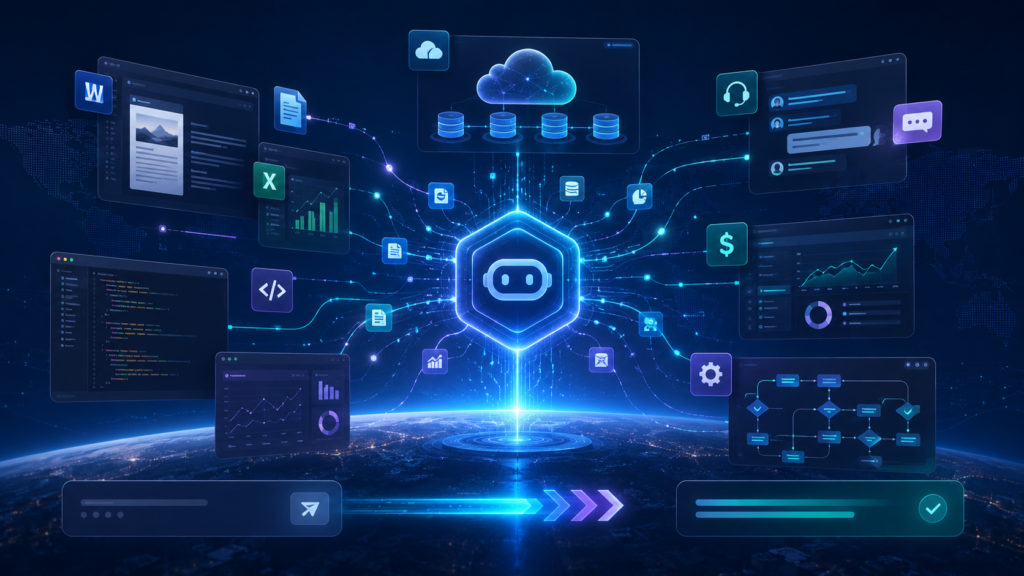
What Comes After the AI Agent Hype?
The first stage of the AI agent market has focused heavily on demonstrations.
Agents browse websites, prepare reports, write code, and complete visible sequences of actions. These demonstrations are useful because they show what the technology could become.
The next stage will be less theatrical.
Organizations will begin asking operational questions:
- Does the agent complete the task consistently?
- Can it handle incomplete or conflicting information?
- What happens when a tool fails?
- Can its actions be traced and audited?
- When should it request human approval?
- How much does each successful outcome cost?
- Can the organization govern hundreds of agents at once?
The market may not be won by the systems that look the most human.
It may be won by the systems that are easiest to control, measure, and operate reliably.
CHA INSIGHT View
AI agents represent a meaningful shift.
They move artificial intelligence from a content-generation interface toward a more active role in business processes.
But apparent intelligence will not determine enterprise adoption.
The decisive layer will be the operating environment around the agent: data, tools, permissions, infrastructure, monitoring, evaluation, and governance.
An agent should not be judged by how confidently it speaks or how many actions it can perform.
It should be judged by whether it completes a defined task safely, consistently, and economically.
For organizations, the most useful question is not:
How autonomous can this agent become?
It is:
What level of autonomy can we operate reliably—and what business result does it justify?
That distinction will determine whether AI agents become durable enterprise systems or remain impressive demonstrations.
Frequently Asked Questions
Is ChatGPT an AI agent?
A conversational AI system can form part of an agent, but a standard chatbot is not automatically an AI agent. An agent generally needs the ability to pursue a goal, use tools, and take actions beyond producing a response.
Do AI agents always use large language models?
No. Software agents existed before modern large language models. Many current agents use LLMs because they are useful for interpreting natural language, processing unstructured information, and selecting possible actions.
Can AI agents work without human supervision?
Some agents can complete limited, low-risk tasks without approval at every step. High-impact enterprise processes usually require permissions, monitoring, escalation rules, and human oversight.
What is the difference between an AI agent and automation?
Traditional automation follows predetermined rules and sequences. An AI agent can interpret an objective, choose among possible actions, and adapt its plan as new information becomes available.
What is AgentOps?
AgentOps refers to the practices and systems used to evaluate, monitor, govern, and improve AI agents in production. It covers more than model performance, including tool use, workflow behavior, permissions, cost, failures, and task outcomes.
Sources and Further Reading
- Microsoft — AI Agents and Enterprise Adoption
- IBM — What Are AI Agents?
- Microsoft Azure — AI Agent Adoption Framework
- Survey on Large Language Model-Based Autonomous Agents
Published by CHA INSIGHT
CHA INSIGHT examines what is changing, what is overstated, and what actually matters.