
How Do the LA Dodgers Afford One of MLB’s Biggest Payrolls?
When a professional athlete signs a contract worth hundreds of millions of dollars, the number itself can be difficult to process. In baseball, those deals have become increasingly common at the top of the market.
That raises an obvious question: How can a team afford to spend that much on players and still operate as a business?
Few teams make that question more interesting than the Los Angeles Dodgers.
The Dodgers have become MLB’s clearest example of aggressive spending. In 2025, they set a Major League Baseball record with roughly $514.6 million in combined payroll and luxury-tax costs. Their spending has remained at the top of the league in 2026, with current estimates again placing their luxury-tax payroll around the $400 million mark. (AP News)
The easy explanation would be that the Dodgers are simply a wealthy team with wealthy owners. That is true to a point, but it misses most of the story.
The Dodgers can support an enormous payroll because the modern sports business extends far beyond ticket sales. Stadium revenue, media rights, sponsorships, merchandise, league-wide income and the commercial pull of superstar players all contribute. Just as importantly, the club is willing to spend a very large share of that money on talent because winning can make the entire business more valuable.
A Strong Starting Point: More Than 4 Million Fans
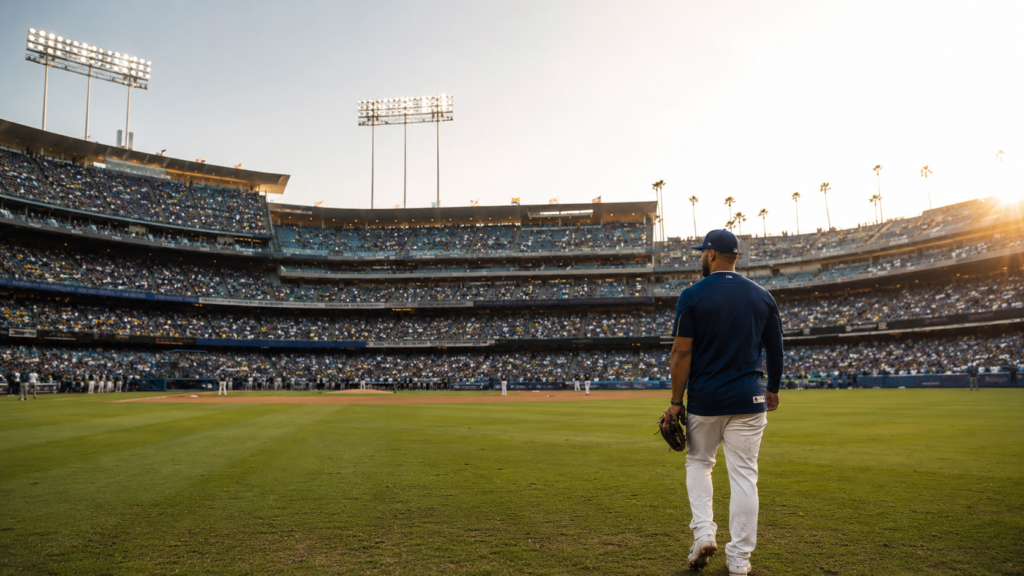
The most visible part of the Dodgers’ business is Dodger Stadium.
In 2025, the club drew 4,012,470 fans during the regular season, passing four million for the first time in franchise history. Average attendance reached 49,537 per home game, and every home date drew at least 40,000 fans. (MLB.com)
That creates substantial ticket revenue. Forbes estimates that the Dodgers generated about $293 million in gate receipts in its latest assessment of the club. (포브스)
But a fan entering the stadium is worth more to the business than the price of a ticket.
There is parking, food and beverage spending, merchandise, premium seating and corporate hospitality. Luxury suites and high-end seating can also bring in far more revenue per customer than ordinary seats.
This is why attendance remains such an important part of the business even for teams with major media contracts. A packed stadium does not simply mean 50,000 tickets were sold. It creates tens of thousands of opportunities for additional spending around the same event.
There is, however, a natural ceiling. A stadium has a fixed number of seats, and an MLB club has 81 regular-season home games.
For a team to build a business large enough to support a payroll like the Dodgers’, the audience has to extend far beyond the ballpark.
The Game Becomes More Valuable Once It Leaves the Stadium
This is where media rights become especially important.
A seat at Dodger Stadium can be sold to one person for one game. A live broadcast of that same game can reach a much larger audience at the same time.
The Dodgers have long benefited from their local media presence through SportsNet LA. More broadly, media rights allow professional teams and leagues to turn games into valuable recurring content rather than relying only on people who physically attend.
That matters because live sports remain unusual in modern entertainment. Fans generally want to watch the game while it is happening. The result is a large, concentrated audience that broadcasters and streaming companies value highly.
A baseball franchise therefore operates partly like a media business. It produces more than 160 regular-season games each year, along with highlights, interviews, analysis and other content surrounding the team.
This also helps explain why player salaries have risen alongside the commercial value of sports media. When a game can generate money from both the stadium audience and a much larger viewing audience, the players at the center of that content become more valuable as well.
Shohei Ohtani’s $700 Million Deal Shows Why Payroll Numbers Can Be Misleading
No Dodgers contract illustrates the complexity of modern sports finance better than Shohei Ohtani’s.
His contract is worth $700 million over 10 years, one of the largest deals in sports history.
But the headline number does not tell you how the Dodgers actually pay him.
Ohtani receives only $2 million in cash each season during the 10-year playing portion of the contract. Another $68 million per year is deferred, with $680 million scheduled to be paid from 2034 through 2043. (Spotrac)
That does not mean Ohtani counts as a $2 million player for MLB’s luxury-tax purposes.
The league calculates the present value of the deferred money. Spotrac currently lists Ohtani at roughly $46.1 million against the Dodgers’ 2026 luxury-tax payroll. (Spotrac)
The distinction is important.
A major sports contract can involve three different numbers: the total value announced publicly, the cash actually paid in a particular year, and the amount recognized under league payroll rules.
For the Dodgers, deferred compensation does not make the obligation disappear. What it does is change the timing of the cash payments.
That gives the club more flexibility in the near term while pushing substantial obligations into later years.
So when fans see a contract worth $700 million, it is not enough to divide that number by 10 and assume that is exactly what leaves the team’s bank account every season.
Why Spend So Much on a Superstar in the First Place?
The simplest answer is winning.
The Dodgers spend heavily because elite players improve their chances of reaching the postseason and competing for championships.
But a player like Ohtani creates value well beyond wins and losses.
A global superstar can attract more viewers, increase merchandise demand, strengthen sponsorship opportunities and introduce the team to fans who may never have followed the club before.
Ohtani is particularly valuable in this respect because his appeal stretches well beyond Southern California. His popularity in Japan and across Asia gives the Dodgers access to an international audience that few individual baseball players can deliver.
That means the economics of his contract cannot be measured only by home runs, pitching statistics or ticket sales.
A superstar can influence almost every part of the business at once: media interest, sponsorships, merchandise, international reach and overall brand recognition.
This is why the largest contracts in sports are better understood as both competitive spending and commercial spending.
The risk, of course, is significant. Players can get injured or decline before a long-term deal ends. A huge contract can become a burden just as easily as it can become a bargain.
That is why signing a superstar is not simply a baseball decision. It is also a financial decision about how much future value one player might create.
The Dodgers Can Spend More — But They Pay Heavily for It
MLB does not use the kind of hard salary cap found in the NFL.
Instead, it uses the Competitive Balance Tax, commonly called the luxury tax.
For 2026, the basic CBT threshold is $244 million. Teams are still free to spend beyond that number, but exceeding it creates additional taxes, and the penalties become more severe for repeat offenders and teams that move far beyond the threshold. (Spotrac)
The Dodgers are far beyond it.
Spotrac currently projects their 2026 luxury-tax payroll at about $396 million, roughly $152 million over the threshold. The resulting estimated tax bill is more than $142 million, pushing combined tax payroll allocations and projected tax above $538 million. (Spotrac)
Those figures can change during a season as contracts and roster moves change, but the broader point remains the same.
The Dodgers are not accidentally paying a massive luxury-tax bill. They have chosen to accept it.
Management has effectively decided that the value of maintaining an elite roster is worth paying both the players and the penalties attached to that spending.
That is a crucial difference between MLB and leagues with stricter salary caps. MLB does not completely stop a rich club from spending far above its rivals. It makes that decision increasingly expensive.
Revenue Matters More Than Payroll Alone
The other half of the equation is how much money the Dodgers generate.
Forbes’ 2026 valuation estimates the franchise at $7.8 billion, up from $6.8 billion a year earlier. It estimates revenue at $850 million, the highest figure in MLB in that assessment.
Those numbers help explain why the Dodgers can operate on a scale unavailable to most teams.
A club that produces hundreds of millions of dollars through ticketing, media, sponsorships, merchandise and other business activity has more room to carry an expensive roster.
But this does not mean all of that revenue becomes profit.
Forbes estimates Dodgers player expenses at about $402 million and operating income at roughly negative $20 million in its latest valuation.
That is an important distinction.
A team can have enormous revenue and still have relatively thin operating margins once player costs and the rest of the organization are taken into account.
The Dodgers also have coaches, front-office employees, scouting and player-development systems, travel costs, facilities, stadium operations and marketing expenses to pay for.
So the question is not simply whether annual revenue exceeds annual payroll.
Ownership may be willing to accept lower short-term operating profit if heavy investment creates a stronger team, a larger audience and a more valuable franchise over time.
The Dodgers’ estimated franchise value rising from $6.8 billion to $7.8 billion in one year illustrates why owners may think beyond a single season’s profit-and-loss statement.

The Dodgers Also Benefit From Being Part of MLB
One team does not build the entire sports business by itself.
The Dodgers compete against the Yankees, Giants, Padres and every other MLB team, but those clubs are also necessary business partners. Without credible opponents and a functioning league, there is no valuable Dodgers product to sell.
That is why major professional leagues share certain forms of revenue.
National media deals and league-wide commercial agreements help create income that goes beyond what each franchise generates locally. MLB also has revenue-sharing mechanisms designed to reduce some of the financial gap between large- and small-market clubs.
The balance varies by sport.
The NFL relies much more heavily on shared national media revenue and operates under a hard salary cap, which limits how far individual teams can separate themselves through payroll.
The NBA also has a salary-cap system, although its rules allow significant flexibility and impose increasingly severe luxury taxes on high-spending teams.
MLB leaves more room for local-market differences. That gives clubs in large, commercially powerful markets greater opportunity to generate revenue that can ultimately support higher spending.
The Dodgers are therefore not just good at spending money. They operate in one of baseball’s strongest markets and have built a business capable of turning that advantage into both revenue and roster strength.
The Real Answer: Payroll Is Part of a Much Larger Business
So how do the LA Dodgers afford one of MLB’s biggest payrolls?
It is not because of one magical revenue source.
Four million fans provide a huge foundation at the stadium. Media rights extend the audience beyond Los Angeles. Sponsorships and merchandise turn fan interest into additional commercial revenue. Global stars such as Ohtani open new audiences and business opportunities. Contract structures can change the timing of cash payments. And the Dodgers are willing to absorb luxury-tax penalties that many other clubs would prefer to avoid. (MLB.com)
The same basic idea applies across professional sports, although each league handles money differently.
The Yankees use the strength of their brand and the New York market. NFL clubs benefit from enormous shared media revenue. NBA teams increasingly rely on media, arena revenue, premium hospitality and international fan bases. Major European soccer clubs combine broadcasting, sponsorships, stadium income, merchandise and international competitions to support their own enormous wage bills.
What makes the Dodgers especially interesting is the scale at which all of these forces come together.
They spend heavily because they can generate huge revenue, but they also spend because they believe elite talent helps them protect and grow that revenue.
That creates a cycle: star players help produce winning teams and attention; attention creates more commercial opportunities; and those resources help finance the next wave of talent.
The cycle is not guaranteed to work. Big spending can fail, and a massive payroll does not automatically produce a championship.
But that is the key to understanding modern professional sports economics.
The Dodgers are not simply paying extraordinarily high salaries because they have a lot of money. They are operating a sports, media and entertainment business in which elite players are both one of the largest costs and one of the most valuable assets.