How the Milwaukee Brewers Won the 2026 World Series: Three Keys to Their Success
The Milwaukee Brewers entered the 2026 postseason with a payroll of approximately $143.5 million, ranking 19th in Major League Baseball. The Los Angeles Dodgers, by comparison, spent approximately $338 million. Milwaukee won 103 regular-season games and its first World Series championship with roughly 42% of the Dodgers’ payroll.
The spending gap makes for a compelling story, but the Brewers were far more than an underdog that got hot in October. They scored 832 runs and allowed 618 during the regular season, producing a plus-214 run differential. Their Pythagorean record—an estimate based on runs scored and allowed—was 103–59, exactly matching their actual record.
Milwaukee had built a championship-caliber team before the playoffs began. Understanding how requires looking beyond payroll to the decisions behind the roster: where the players came from, how they improved, and how their skills fit together.
1. Connecting Talent Acquisition With Player Development
The Brewers’ World Series roster included 15 players acquired through trades, seven selected in the draft, three signed as international amateurs, and just one major-league free-agent signing: backup catcher Gary Sánchez.
Those numbers describe the roster’s origins. The more important question is how Milwaukee turned those acquisitions into a competitive team. Homegrown players became stars, while trade acquisitions filled essential positions and continued developing after arriving.
- Finding impact players through the draft and international scoutingBrice Turang was the 21st overall pick in 2018, and Garrett Mitchell went 20th overall in 2020. Jacob Misiorowski was a second-round selection in 2022, while Jackson Chourio signed as an international amateur in 2021.Milwaukee did more than develop useful roster pieces. It produced players capable of carrying a contender.
| Player | Position | 2026 regular-season performance | bWAR |
|---|---|---|---|
| Brice Turang | Second baseman | 21 HR, .366 OBP, .816 OPS | 7.3 |
| Jackson Chourio | Outfielder, primarily left field | 25 HR, 23 SB, .837 OPS | 4.9 |
| Jacob Misiorowski | Right-handed starting pitcher | 174⅔ IP, 1.80 ERA, 252 K | 6.5 |
Source: Baseball-Reference. bWAR is Baseball-Reference’s version of Wins Above Replacement.
Together, the three contributed 18.7 bWAR. Players Milwaukee had identified and developed were now leading the team on both sides of the ball.
- Turning trade returns into further reinforcementsThe 2022 Josh Hader trade brought Milwaukee a package that included Esteury Ruiz and Robert Gasser. Ruiz was subsequently used to acquire William Contreras, while Gasser developed into a starter and won Game 3 of this year’s World Series.That sequence illustrates why a trade cannot always be judged solely by the immediate performance of the players received. A prospect can become a contributor, provide depth, or help complete another acquisition.
| Trade | Key assets acquired | Subsequent use |
|---|---|---|
| Josh Hader, 2022 | Esteury Ruiz, Robert Gasser, and others | Ruiz helped bring in Contreras; Gasser joined the rotation |
| Corbin Burnes, 2024 | Joey Ortiz, DL Hall, and the No. 34 draft pick | Added infield and pitching options, plus another draft opportunity |
Trade details: The Ringer and the Brewers’ official announcement.
Ortiz and Hall did not directly replace Burnes in the rotation. Instead, Milwaukee addressed the loss through contributions elsewhere on the roster and the development of other pitchers. That distinction matters: maintaining a competitive team is different from finding a one-for-one replacement for every departing star.
- Improving players after acquiring themContreras’ defense provides a measurable example. His Statcast framing value improved from minus-three runs in 2022 to plus-seven in 2023, his first season in Milwaukee.Trevor Megill followed a different development path, refining the combination of his high-velocity fastball and knuckle curve to become a key late-inning reliever.
The Brewers were acquiring players with existing strengths and finding ways to make them more complete. Combined with their homegrown talent, that helped them remain competitive through significant roster turnover.
2. Adding Harder Contact to a Selective Offensive Approach
Milwaukee’s offensive development was more nuanced than a simple jump in overall production. Its park- and league-adjusted offensive output remained similar, but the quality of its contact improved.
| Metric | 2025 | 2026 |
|---|---|---|
| wRC+ | 107 | 107 |
| Brewers hard-hit rate | 39.3% | 40.3% |
| MLB hard-hit rate | 41.0% | 38.7% |
Hard-hit rate measures the share of batted balls hit at least 95 mph. A wRC+ of 100 represents league-average offense.
Milwaukee’s hard-hit rate rose by one percentage point while the league average fell by 2.3 points. The Brewers moved from below the league average to above it.
The changes behind that shift involved pitch selection, swing mechanics, and adjustments tailored to individual hitters.
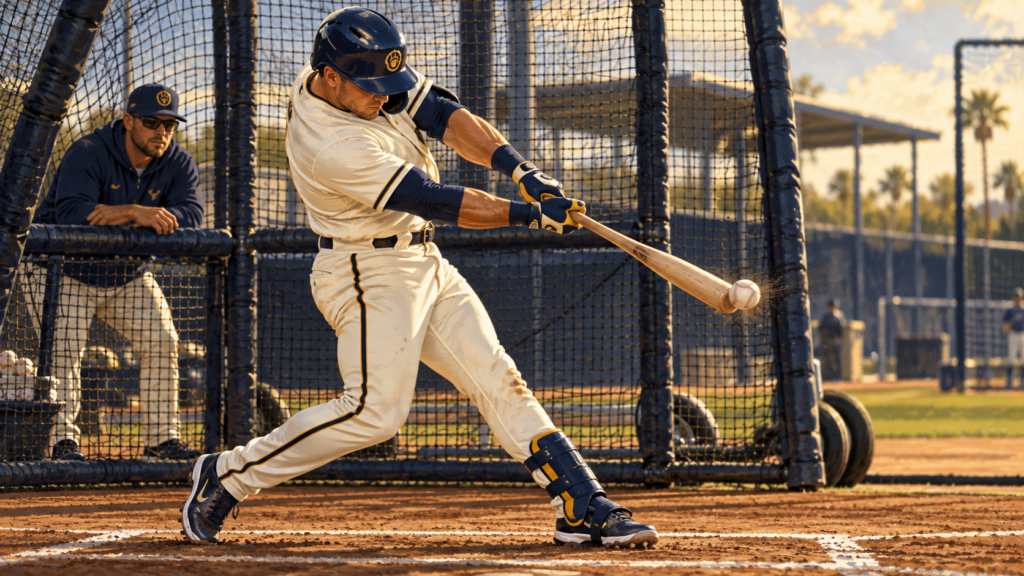
- Choosing pitches that fit each hitter’s strengthsMilwaukee’s hitting staff emphasized selecting pitches that individual hitters could attack effectively.A strike is not automatically a good pitch to hit. Location, pitch shape, and a hitter’s swing all influence the quality of contact. The objective was to recognize pitches that allowed hitters to take their best swings, rather than simply trying to extend every plate appearance.
- Increasing bat speed while preserving contact skillsTurang’s swing analysis showed increased bat speed while retaining much of his short, compact stroke.That balance matters. A longer swing may create more power, but it can also introduce timing problems or reduce contact. Turang’s development focused on adding force without giving away the qualities that already made him an effective contact hitter.
- Making adjustments specific to each playerAn analysis of Milwaukee’s swing changes found that Mitchell moved his contact point approximately 1.5 inches farther forward. He had one home run through mid-May and added 10 over the remainder of the regular season.Jake Bauers adjusted his contact point and upward swing path, while Chourio changed his pitch targeting and swing shape. The objective was similar, but the mechanical solutions differed.
Those adjustments should not be treated as a complete explanation for every subsequent home run. Playing time, health, opposing pitchers, and normal variation also affect results.
The broader change, however, is clear. Milwaukee maintained its ability to get on base and make contact while adding more force to its offense. Against pitchers who rarely allow several consecutive hits, that gave the Brewers another way to turn limited opportunities into runs.
3. Building a Bullpen That Could Cover More Than Fixed Innings
Misiorowski’s regular season established him as Milwaukee’s ace. Across 30 starts, he threw 174⅔ innings with a 1.80 ERA, 252 strikeouts, and 44 walks—a strikeout-to-walk ratio of approximately 5.7 to one.
Yet his first two postseason starts ended before he completed five innings. Milwaukee entered the World Series needing both an adjustment from its ace and a reliable plan for the innings behind him.
- Investigating mechanical changes behind the resultsBefore the World Series, the coaching staff examined Misiorowski’s deeper lower-body movement and slower delivery. The time between lifting his leg and planting his foot had increased from approximately 0.8 seconds to 1.1 seconds.He subsequently allowed one run over five innings in Game 1 and pitched 5⅔ scoreless innings in Game 5.Those results do not establish that every issue with his fastball had been resolved. They do show that he provided more innings and limited damage more effectively than he had in the preceding rounds.
- Combining late-inning relief with multi-inning coverageMegill recorded 30 regular-season saves, while Aaron Ashby carried a substantially larger innings workload. Abner Uribe provided another high-quality option between the starter and the final out.
| Pitcher | Regular-season IP | Regular-season ERA | World Series games | World Series IP | World Series ERA | World Series K |
|---|---|---|---|---|---|---|
| Trevor Megill | 61⅔ | 2.63 | 3 | 3⅓ | 5.40 | 5 |
| Abner Uribe | 59⅓ | 1.97 | 4 | 5⅓ | 0.00 | 5 |
| Aaron Ashby | 89⅓ | 3.12 | 3 | 5⅔ | 0.00 | 9 |
Final 2026 regular-season and World Series statistics.
Uribe and Ashby combined for 11 scoreless World Series innings and 14 strikeouts. Their contributions also illustrate why bullpen performance should be assessed collectively: the three pitchers did not produce identical results, but Milwaukee had several options for covering important outs.
- Developing a reliever’s preparation routineAshby said he initially needed one or two innings’ notice in early 2025, but could sometimes prepare within 90 seconds by season’s end.For a former starter, adapting to an unpredictable entry point is part of becoming a useful reliever. Multi-inning ability has greater tactical value when a pitcher can also respond quickly to an unexpected situation.
- Using multi-inning relief to absorb short startsAshby finished the postseason with 18 scoreless innings across nine appearances. He allowed five hits and three walks while striking out 20, producing a 0.44 WHIP.He averaged two innings per appearance without allowing a run. That helped Milwaukee bridge the gap after shorter starts without immediately exhausting its remaining relievers.
The Brewers could not guarantee an 18-inning scoreless postseason from Ashby. What they could prepare was a bullpen with pitchers capable of handling different assignments. In October, that flexibility was matched by exceptional execution.
The Contributions Beyond the Three Main Factors
Milwaukee also benefited from details that do not fit neatly into roster construction, swing changes, or bullpen usage.
Contreras hit .381 in the World Series, caught four attempted base stealers, and succeeded on 10 of 13 ABS challenges. Rookie shortstop Cooper Pratt hit .421 with seven RBIs, giving the Brewers another decisive contributor on the biggest stage.
Pat Murphy’s influence extended beyond pitching changes and lineup decisions. He established clear expectations for effort, removing established players when their baserunning fell short. Veteran leaders Christian Yelich and Brandon Woodruff helped uphold those standards inside the clubhouse.
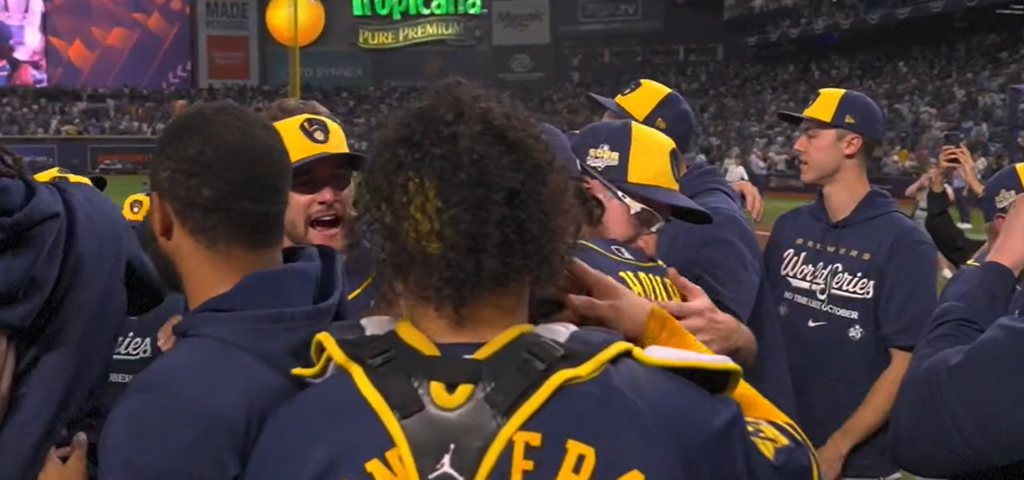
Milwaukee’s championship was built through years of scouting, development, and roster decisions. It was completed by players delivering in October and a team culture that demanded the same commitment from veterans and rookies alike.
The Brewers’ payroll made their title remarkable. The quality of the team they assembled made it possible.